
Is 2,000 IU of Vitamin D Enough After 60?

Nature Made Vitamin D3 2000 IU
The right pick for most adults over 60 who simply want a reliable maintenance dose: 2,000 IU of D3 per softgel, USP Verified, and a few cents a day in the larger bottle sizes.
- USP Verified for purity and potency
- 2,000 IU (50 mcg) per softgel — the standard maintenance dose
- Cholecalciferol (D3) form, better absorbed than D2
For most adults over 60, 2,000 IU (50 mcg) of vitamin D3 a day is enough — and then some. The official recommended intake is 600 IU daily up to age 70 and 800 IU after 70, so 2,000 IU gives you a comfortable margin while staying well below the 4,000 IU upper limit set for adults. The exceptions matter, though: if you have a confirmed deficiency, absorb fat poorly, carry extra weight, or almost never get sun, you may need more for a while — and that decision belongs to a blood test and your doctor, not a guess.
The Detailed Answer
Here’s what the research actually shows. The National Institutes of Health Office of Dietary Supplements sets the recommended dietary allowance (RDA) for vitamin D at 600 IU (15 mcg) per day for adults aged 51 to 70, and 800 IU (20 mcg) per day for adults over 70. Those numbers are built around bone health — enough vitamin D to support calcium absorption and keep bone loss in check.
A 2,000 IU daily dose is roughly two and a half times the RDA for someone over 70. That sounds like a lot until you remember two things: the RDA assumes minimal sun exposure even though skin synthesis and kidney conversion both decline with age, and the tolerable upper intake level for adults is 4,000 IU (100 mcg) per day. So 2,000 IU sits in the middle — a generous, not excessive, daily amount.
Most clinical labs consider a blood 25-hydroxyvitamin D — written 25(OH)D — level of 20 ng/mL adequate for bone health, with many clinicians preferring 30 ng/mL or higher. Blood levels typically climb fastest in the first two to three months on a new dose and then level off, which is why retesting is usually done around then rather than sooner. In the VITAL trial, which gave a large group of older adults 2,000 IU of D3 daily, most participants in the blood substudy reached the 30 ng/mL range within the first year. That trajectory is a big part of why 2,000 IU has become the default maintenance dose on so many supplement labels.
When 2,000 IU is probably plenty
If you eat some fatty fish or fortified dairy, get outdoors in warm months, have normal kidney function, and have never been told your vitamin D is low, 2,000 IU a day is a sensible maintenance dose. It closes the winter gap without pushing you near the upper limit.
This is the tier where a simple, well-tested product does the whole job. Nature Made Vitamin D3 2000 IU is USP Verified — meaning an independent organization confirmed the potency and purity of what’s in the softgel — and runs about $12 for a standard bottle, with larger counts bringing the cost down to a few cents a day. It uses cholecalciferol (D3), which is better absorbed and longer-acting than the D2 form.
When 2,000 IU may not be enough
Several situations raise the dose you need to reach the same blood level:
- A confirmed deficiency. If your 25(OH)D comes back below 20 ng/mL, a standard regimen is 50,000 IU of vitamin D once a week (or about 6,000 IU daily) for roughly 8 weeks, then a step-down to a 1,500–2,000 IU maintenance dose.
- Higher body weight. Vitamin D is fat-soluble and distributes into fat tissue, so the same dose produces a lower blood level in people with more body fat.
- Fat malabsorption. Celiac disease, Crohn’s disease, chronic pancreatitis, or past gastric bypass or gastrectomy all reduce absorption of a fat-soluble vitamin.
- Very limited sun exposure. Homebound adults, people in northern latitudes through winter, and those who cover their skin or use sunscreen consistently.
- Certain medications. Some anticonvulsants, glucocorticoids, and the weight-loss drug orlistat lower vitamin D levels or absorption.
The Endocrine Society has argued that adults at risk for deficiency may need 1,500–2,000 IU daily just to reach 30 ng/mL, and that some need considerably more. That is a real clinical debate, not settled science — which is exactly why testing beats guessing. If you and your doctor land on a repletion dose, NatureWise Vitamin D3 5000 IU delivers 5,000 IU per softgel in an organic olive oil base for about $15, though it is not meant to be a lifelong maintenance dose and the softgel cannot be split.
Is 2,000 IU ever too much?
For a healthy adult, no. Toxicity — a buildup of calcium in the blood that can bring an upset stomach and vomiting, weakness, frequent urination, bone pain, and kidney problems such as calcium stones — is what Mayo Clinic associates with sustained intakes above 4,000 IU a day, though documented poisoning cases typically involve doses far higher than that — typically tens of thousands of IU a day sustained for weeks or months. Two thousand IU is not in that territory.
There are people who should be more careful even at modest doses: anyone with chronic kidney disease, hyperparathyroidism, sarcoidosis, or a history of calcium-containing kidney stones. Thiazide diuretics such as hydrochlorothiazide reduce how much calcium your kidneys excrete, so combining them with vitamin D plus a calcium supplement can push blood calcium too high. Vitamin D also interacts with digoxin, where elevated calcium raises the risk of abnormal heart rhythms. And stacking a multivitamin, a calcium-with-D tablet, and a standalone D3 softgel is how people accidentally reach 4,000 IU or more without realizing it — add up every label.
When a blood test is worth asking for
A 25(OH)D test is reasonable if you have osteoporosis or a low-trauma fracture, chronic kidney or liver disease, a malabsorption condition, unexplained muscle weakness or bone pain, are taking one of the medications above, or are considering a dose above 2,000 IU. Retesting three months after a dose change tells you whether it worked. Routine screening of healthy adults with no risk factors is not generally recommended — the Preventive Services Task Force has repeatedly found the evidence insufficient. If you want to know what low levels feel like before you ask, our guide to the signs of vitamin D deficiency after 50 walks through the symptoms that are worth mentioning at your next visit.
Related Questions
How much vitamin D should a 70-year-old take?
The NIH RDA for adults over 70 is 800 IU (20 mcg) daily, and the upper limit is 4,000 IU. In practice, most clinicians are comfortable with 1,000–2,000 IU daily as maintenance for this age group, because skin synthesis and kidney activation both decline after 70. Anything above 2,000 IU is worth a conversation with your doctor and a 25(OH)D test first.
Does 2,000 IU of vitamin D need to be taken with food?
Yes — vitamin D is fat-soluble, and taking it with a meal that contains some fat meaningfully improves absorption. A softgel taken with breakfast, lunch, or dinner works; taken on an empty stomach with coffee, less of it gets in. Our page on whether to take vitamin D with or without food covers how much of a difference the meal actually makes.
Do I need vitamin K2 with my vitamin D?
The evidence is suggestive rather than settled. K2 helps direct calcium into bone and away from arterial walls, which is a reasonable rationale for pairing it, but a systematic review of randomized controlled trials found no consistent evidence that K2 lowers fracture risk beyond vitamin D alone, and large trials on cardiovascular outcomes are lacking too. If you want the combination, Thorne D3/K2 Liquid provides 500 IU of D3 plus 100 mcg of K2 per drop and is NSF Certified for Sport, at about $25 a bottle. Important caveat: vitamin K interacts with warfarin, so do not add K2 without clearing it with your prescriber.
Which vitamin D supplement should I actually buy?
Look for D3 (cholecalciferol) rather than D2, a dose that matches your blood level and your doctor’s advice, and a third-party seal — USP Verified, NSF, or ConsumerLab tested — because supplements are not pre-approved by the FDA for potency. Avoid “proprietary blend” labels that hide how much D3 you’re actually getting. Our roundup of the best vitamin D supplements for seniors compares forms, doses, and prices side by side.
When to Talk to Your Doctor
Consult your doctor or pharmacist before starting or changing a vitamin D dose if any of these apply to you:
- You take a thiazide diuretic (hydrochlorothiazide, chlorthalidone), digoxin, warfarin (relevant if you add K2), a glucocorticoid, or an anticonvulsant.
- You have chronic kidney disease, hyperparathyroidism, sarcoidosis, or a history of calcium kidney stones.
- You are also taking calcium supplements — the combination, not the vitamin D alone, is what raises blood calcium.
- You are considering a dose above 2,000 IU daily, or someone has suggested 10,000 IU.
- You have unexplained fatigue, muscle weakness, or bone pain, or you’ve had a fracture from a minor fall.
Bring every bottle — or a photo of every label — to the appointment. A pharmacist can add up the vitamin D across your multivitamin, your calcium tablet, and your standalone D3 in about a minute, which is the single most useful thing anyone can do with this question.
The bottom line: 2,000 IU a day is enough for most adults over 60, safely under the 4,000 IU ceiling and comfortably above the 600–800 IU requirement. If you think you need more, get the blood test that proves it.
Sources:
-
Sanders KM et al. Annual high-dose oral vitamin D and falls and fractures in older women: a randomized controlled trial. JAMA. 2010;303(18):1815-1822 — the 500,000 IU annual-dose trial that found more falls and fractures
-
Vitamin D — Health Professional Fact Sheet, NIH Office of Dietary Supplements — Source for the 600 IU (51–70) and 800 IU (71+) RDA, the 4,000 IU upper limit, 20 vs 30 ng/mL blood thresholds, IU-to-mcg conversion, and interactions with thiazide diuretics, digoxin, orlistat, glucocorticoids and anticonvulsants.
-
Endocrine Society Clinical Practice Guideline: Evaluation, Treatment, and Prevention of Vitamin D Deficiency — Supports the higher-dose discussion — that adults at risk may need 1,500–2,000 IU daily to reach 30 ng/mL — and the repletion regimen of 50,000 IU weekly (about 6,000 IU/day) for 8 weeks for confirmed deficiency.
-
Vitamin D Deficiency in Adults: Screening — U.S. Preventive Services Task Force — Supports the statement that routine 25(OH)D screening of asymptomatic adults is not recommended due to insufficient evidence.
-
Vitamin D toxicity — Mayo Clinic — Supports the description of vitamin D toxicity symptoms and the “>4,000 IU/day” caution threshold.
-
Vitamin K — Health Professional Fact Sheet, NIH Office of Dietary Supplements — Supports the warfarin interaction warning for vitamin K2 and the MK-4 versus MK-7 half-life difference.
-
Vitamin D Supplements and Prevention of Cancer and Cardiovascular Disease (VITAL trial) — Manson et al., NEJM 2019 — The randomized trial behind the 2,000 IU/day dosing discussed above: 25,871 older adults took 2,000 IU of D3 daily for a median of 5.3 years.
-
Efficacy of vitamin K2 in the prevention and treatment of postmenopausal osteoporosis: a systematic review and meta-analysis of randomized controlled trials — Supports the statement that large trials showing a fracture-risk benefit from D3+K2 over D3 alone are lacking.
Products We Recommend
- USP Verified for purity and potency
- 2,000 IU (50 mcg) per softgel — the standard maintenance dose
- Cholecalciferol (D3) form, better absorbed than D2
- About $12 a bottle; larger counts bring the per-day cost down to a few cents
- No vitamin K2 included — pair separately if you want it
- Requires a meal with some fat for best absorption
- May take 8–12 weeks to fully raise a low blood level
- Only addresses fatigue that is caused by deficiency
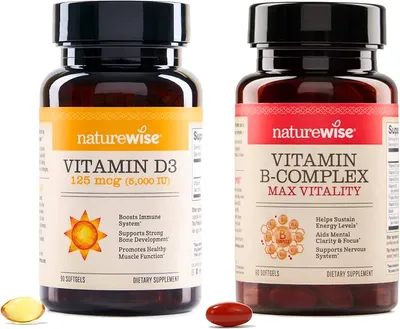
- 5,000 IU per softgel — a common repletion dose
- Organic cold-pressed olive oil base aids absorption of a fat-soluble vitamin
- Non-GMO, gluten-free, and free of common allergens
- About $15 per bottle
- Too high for routine maintenance without medical supervision
- Softgel cannot be split to lower the dose
- No USP or NSF certification
- No vitamin K2 included
- Adjustable dosing — 500 IU D3 + 100 mcg K2 per drop
- NSF Certified for Sport third-party testing
- Liquid form suits anyone with difficulty swallowing pills
- Very low cost per serving despite the $25 bottle
- Higher upfront price of about $25
- Uses MK-4 K2, which has a shorter half-life than MK-7
- Requires counting drops carefully with the metered dropper
- Vitamin K interacts with warfarin — clear it with your prescriber first
Frequently Asked Questions
Is 2,000 IU of vitamin D too much for a person over 60?
No. The tolerable upper intake level for adults is 4,000 IU (100 mcg) per day, so 2,000 IU leaves substantial room. Documented toxicity cases typically involve much higher sustained intakes — tens of thousands of IU a day for weeks to months — not 2,000 IU. The exception is anyone with kidney disease, hyperparathyroidism, sarcoidosis, or a history of calcium kidney stones, who should confirm any dose with their doctor.
How long does 2,000 IU of vitamin D take to raise my blood level?
Expect 8 to 12 weeks before your 25(OH)D blood level fully stabilizes at a new dose. That is why doctors usually retest about three months after a dose change rather than a few weeks in. If you started because of fatigue, keep in mind that vitamin D only helps fatigue that was caused by the deficiency in the first place.
What is 2,000 IU of vitamin D in micrograms?
2,000 IU of vitamin D equals 50 micrograms (mcg). Many labels now list both units because the FDA switched supplement facts panels to micrograms, so 25 mcg is 1,000 IU and 100 mcg is 4,000 IU — the upper limit for adults.
Should I take 2,000 IU every day or 14,000 IU once a week?
Because vitamin D is fat-soluble and stored in body tissue, weekly dosing can produce similar average blood levels to daily dosing. Daily is generally preferred for simplicity and steadier levels, and very large intermittent doses — such as a single 500,000 IU annual dose — were linked to more falls and fractures in a randomized trial of older women (Sanders et al., JAMA 2010). Ask your doctor before switching to an intermittent schedule.
Can I get enough vitamin D from sunlight after 60?
It becomes harder. Skin produces less vitamin D with age, and kidney conversion to the active form also declines, so the same amount of sun yields less than it did at 30. Latitude, season, skin tone, and sunscreen all matter too — which is why a modest daily supplement is often more reliable than relying on sun exposure.