
Best Fish Oil for Men Over 60 (2026)
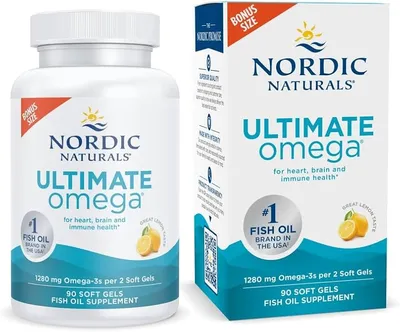
Nordic Naturals Ultimate Omega
The best all-round choice for men over 60 who want a full 1 g of EPA+DHA in one two-softgel dose, with top-tier purity testing and almost no fishy aftertaste.
- 1,280 mg omega-3s (1,100 mg EPA+DHA) per 2-softgel serving
- Triglyceride form for better absorption
- IFOS 5-star rated for purity, including mercury, PCBs, and oxidation
Men over 60 buy fish oil for specific reasons: a cardiologist mentioned it after a stent, triglycerides came back high, or a brother had a heart attack at 62. The pick that suits most of them is Nordic Naturals Ultimate Omega at about $38 — 1,280 mg of omega-3s per two-softgel serving, of which 1,100 mg is EPA+DHA, in the triglyceride form that absorbs more readily. If cost matters more than capsule count, Kirkland Fish Oil works out to roughly $0.07 a day at about $15 for 400 softgels, though at 300 mg of EPA/DHA per capsule you will be swallowing three or four. Most men do well targeting about 1 g of combined EPA+DHA daily — and clearing it with a doctor if they take a blood thinner or blood-pressure medication.
Our Top Picks at a Glance
All five products below are ones we have reviewed and scored. The table shows the numbers that actually matter when you are comparing bottles: EPA+DHA per serving, the oil form, and what you pay.
| Product | Best for | Key spec | Price | Our rating |
|---|---|---|---|---|
| Nordic Naturals Ultimate Omega | Best overall | 1,280 mg omega-3s (1,100 mg EPA+DHA) per 2 softgels, triglyceride form | about $38 | 4.8/5 |
| Kirkland Fish Oil | Best value | 300 mg EPA/DHA per capsule, USP verified | about $15 | 4.2/5 |
| Viva Naturals Omega-3 | Most EPA/DHA per serving | 2,200 mg fish oil with 1,400 mg EPA/DHA per serving, triglyceride form | about $25 | 4.5/5 |
| Nordic Naturals ProOmega | Also consider | EPA/DHA differs by label version | about $30 | 4.5/5 |
| Nordic Naturals EPA Xtra | High-EPA formula for mood support | 1,060 mg EPA per 2-softgel serving | about $38 | 4.7/5 |
If you want the broader field, including options we did not shortlist for men specifically, see our best omega-3 fish oil supplements for seniors roundup.
How We Evaluated
We ranked these products on four things. First, the EPA+DHA number on the back of the label — not the “fish oil” number on the front, which includes fats that do nothing for your heart. Second, purity and third-party testing: IFOS star ratings, USP verification, and published results for mercury, PCBs, and oxidation, since fish oil that has gone rancid tastes bad and delivers less. Third, cost per gram of EPA+DHA rather than cost per bottle, because a cheap capsule you have to take four times a day is not always the cheaper option. Fourth, the practical complaints men actually report to us: softgel size, reflux, and fishy burps.
We did not weigh marketing claims about testosterone, prostate health, or joint comfort, because the human evidence for fish oil in those areas is thin. Here’s what the research actually supports for men over 60: triglyceride lowering, a small blood-pressure effect, and a possible modest benefit for men who already have coronary heart disease and eat little fish.
Detailed Reviews
Best Overall: Nordic Naturals Ultimate Omega
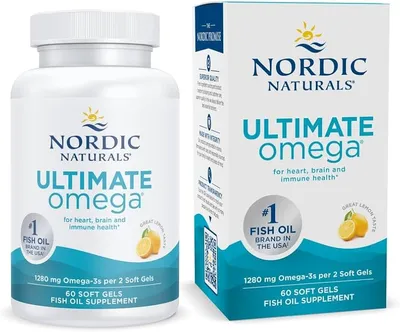
Nordic Naturals Ultimate Omega is the one we recommend most often to men over 60 who want a single product that covers a therapeutic dose without guesswork. Two softgels give 1,280 mg of total omega-3s with 1,100 mg of EPA+DHA — right at the 1 g daily amount the American Heart Association has recommended for people with established coronary heart disease. The oil is in the triglyceride form, the same chemical form found in fish, which absorbs somewhat better than the ethyl ester form used in most budget products. It carries a 5-star IFOS rating covering mercury, PCBs, and oxidation, and the lemon flavoring means most men report minimal fish burps.
Pros
- 1,100 mg EPA+DHA per two-softgel serving hits a 1 g target in one dose
- Triglyceride form for better absorption
- IFOS 5-star rated for purity, including mercury, PCBs, and oxidation
- Lemon-flavored, so fishy aftertaste is uncommon
Considerations
- Premium price at about $38
- Two softgels per serving, and they are large
- Costs noticeably more than a warehouse-club fish oil
Verdict: If you can spend about $38 a bottle, this is the cleanest path to 1 g of EPA+DHA a day with the fewest capsules and the fewest complaints.
Best Value: Kirkland Fish Oil
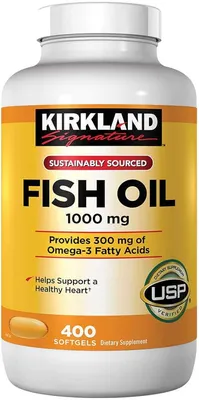
Kirkland Fish Oil is the pick for men who want basic omega-3 coverage and would rather not spend $35 a month to get it. At about $15 for 400 softgels, it works out to roughly $0.07 per day, and it is USP verified, which means an independent organization has checked identity, potency, and contaminant limits. That combination — cheap and tested — is rare.
The trade-off is concentration. Each capsule provides 300 mg of EPA/DHA, so reaching 1 g a day means three or four capsules. It is also an ethyl ester oil, which absorbs less efficiently than triglyceride-form oil, and men with reflux tell us it repeats on them more than the flavored premium brands do. Taking it with a full meal helps.
Pros
- Roughly $0.07 per day, about $15 for 400 softgels
- USP verified for basic quality assurance
- Widely available at Costco, easy to restock
Considerations
- Only 300 mg EPA/DHA per capsule, so 3–4 daily
- Ethyl ester form, with lower absorption than triglyceride form
- More likely to cause fishy burps and reflux
Verdict: Best pure-budget choice for baseline omega-3 support, as long as you are willing to swallow several capsules a day to reach a meaningful dose.
Most EPA/DHA per Serving: Viva Naturals Omega-3
Viva Naturals Omega-3 sits between the two picks above and, for a lot of men, splits the difference well. A serving delivers 2,200 mg of fish oil with 1,400 mg of EPA/DHA — more than our top pick per serving — in the triglyceride form, and it is IFOS certified for purity. At about $25, it gives you a higher per-serving dose than Ultimate Omega at a lower price per bottle; if raw cost per gram is all that matters, plain Kirkland still wins, but not in the better-absorbed triglyceride form.
That higher dose is useful if your doctor has asked you to push toward 2 g a day for high triglycerides, since one serving gets you most of the way. The softgels are large, some men report a mild aftertaste, and the capsules contain gelatin, so it is not suitable if you avoid animal-derived ingredients.
Pros
- 2,200 mg fish oil with 1,400 mg EPA/DHA per serving
- Triglyceride form for strong absorption
- IFOS certified for purity
- Good mid-range price at about $25
Considerations
- Contains gelatin, so not suitable for vegetarians
- Some users report a mild aftertaste
- Less clinical recognition than Nordic Naturals
Verdict: The strongest per-serving dose here for the price, and the one to choose if you need more than 1 g of EPA+DHA a day without doubling your capsule count.
Also Consider: Nordic Naturals ProOmega
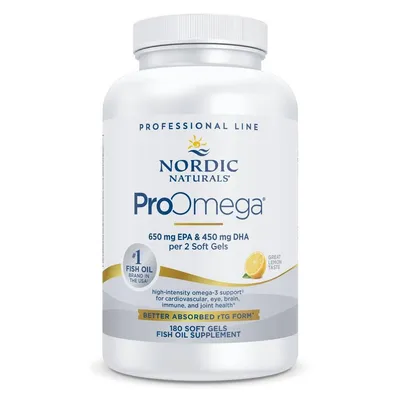
Nordic Naturals ProOmega comes from the same manufacturer as our top pick and earned 4.5/5 in our reviews at about $30. It is a reasonable choice when it is the bottle in front of you at the pharmacy, and Nordic Naturals publishes a batch certificate of analysis for its fish oils, so you can check purity and freshness results yourself.
The one thing to watch is the label. ProOmega is sold in several variations, and the EPA/DHA per serving differs between them, so read the supplement facts panel and compare that number against the 1,100 mg in Ultimate Omega before assuming you are getting the same dose.
Pros
- From the same manufacturer as our top pick
- Mid-tier price at about $30
- 4.5/5 in our reviews
Considerations
- Sold in several variations, so EPA/DHA per serving differs by label
- Costs more than budget fish oils
Verdict: A capable Nordic Naturals alternative at about $30 — just check the specific label’s EPA/DHA before you buy.
Best High-EPA Option: Nordic Naturals EPA Xtra
Nordic Naturals EPA Xtra is a niche pick, and worth considering for one situation: a man over 60 whose main goal is mood support rather than cholesterol numbers. It provides 1,060 mg of EPA per two-softgel serving in the triglyceride form with IFOS 5-star certification, and the antidepressant trial literature has generally been more favorable for high-EPA formulas than for balanced EPA/DHA products. Low mood after retirement, bereavement, or a cardiac event is common in men and often goes unmentioned at appointments — this is a conversation for your doctor, not a supplement decision to make alone, and fish oil is not a substitute for treatment.
Pros
- 1,060 mg EPA per two-softgel serving — a genuinely high-EPA formula
- Triglyceride form, IFOS 5-star certified
- More antidepressant evidence with high-EPA than with balanced EPA/DHA
- Lemon flavor minimizes fish burps
Considerations
- Premium price at about $38
- Less DHA than balanced products, so not the right pick if brain and memory support is also a goal
Verdict: Choose this only if EPA is what you are after; for general heart support, the balanced products above make more sense.
Buyer’s Guide: What to Look For
Fish oil labels are built to confuse. A bottle shouting “1,000 mg Fish Oil” may contain only 300 mg of the two fats that do the work. Here is how to read past that, and what men over 60 specifically need to know.
Read the EPA+DHA number, not the fish oil number
Add the EPA and DHA figures on the supplement facts panel and ignore everything else on the front label. That sum is your dose. The National Institutes of Health Office of Dietary Supplements notes there is no established recommended daily amount for EPA and DHA, but the American Heart Association advises two servings of fish per week — about 3 ounces cooked each — and its 2002 scientific statement recommended roughly 1 g of EPA+DHA per day for people who already have coronary heart disease.
For a full dose breakdown by age and medication status, see how much fish oil a 65-year-old should take.
Dose: 1 g for heart health, 2–4 g only under supervision
Most men over 60 land at 1,000 mg of combined EPA+DHA daily. Higher doses are for specific problems and specific supervision. In REDUCE-IT, a 2019 trial of 8,179 statin-treated patients with elevated triglycerides, 4 g a day of prescription icosapent ethyl was associated with a 25% lower relative risk of major cardiovascular events over a median 4.9 years — but that was a prescription drug, not a fish oil capsule, and the same trial saw more hospitalizations for atrial fibrillation. The STRENGTH trial, published in JAMA in 2020 with 13,078 patients, tested a different 4 g omega-3 preparation and found no cardiovascular benefit, with atrial fibrillation in 2.2% of the omega-3 group versus 1.3% of controls.
The practical read: 1 g is the sensible self-directed dose. If you have a history of atrial fibrillation or palpitations, discuss any dose above that with your cardiologist before starting. The Office of Dietary Supplements notes the FDA has recommended consuming no more than 3 g a day of EPA and DHA combined, including no more than 2 g a day from supplements.
Interactions men over 60 are most likely to have
By 60, most men take at least one prescription, and three categories matter here.
- Blood thinners and antiplatelets — warfarin, apixaban, rivaroxaban, clopidogrel, and daily aspirin. Fish oil has a mild effect on platelet function, and Mayo Clinic notes the combination may raise bleeding risk. It is not a reason to avoid fish oil, but it is a reason to tell your prescriber and to mention it before any surgery, dental extraction, or colonoscopy with planned polyp removal.
- Blood-pressure medication — omega-3s themselves lower blood pressure slightly. A 2022 dose-response meta-analysis in the Journal of the American Heart Association pooling 71 trials and 4,973 participants found that about 2–3 g a day was associated with reductions of roughly 2–3 mmHg systolic. Small, but it can add to your medication, so keep an eye on home readings when you start.
- Statins — no meaningful interaction. Fish oil is commonly taken alongside atorvastatin or rosuvastatin, and it lowers triglycerides through a different route than statins lower LDL.
Fish oil is also generally not recommended in the days before planned surgery, and men with a known fish or shellfish allergy should avoid it entirely.
What about fish oil and prostate cancer?
This is the question men over 60 search for most, and it deserves a straight answer. In 2013, a study in the Journal of the National Cancer Institute using blood samples from the SELECT trial reported that men with higher blood levels of long-chain omega-3s had a 43% higher rate of prostate cancer overall and 71% higher for high-grade disease. That finding got heavy press coverage.
What it does not show is causation. It measured a single blood sample, could not distinguish fish from supplements, and has not been reproduced consistently, and no randomized trial has shown that taking fish oil raises prostate cancer risk. The honest summary is that the evidence is inconsistent and the absolute risk implied is small. If you have a personal or family history of prostate cancer or an elevated PSA, raise it with your urologist rather than deciding from a headline.
Third-party testing and red flags
Fish oil is one of the few supplements where independent testing genuinely changes what you get, because oil oxidizes. Look for an IFOS star rating, USP Verified, NSF certification, ConsumerLab approval, or a published batch certificate of analysis on the label or the brand’s website. Every product on this list has at least one of those.
Red flags worth walking away from: a “proprietary omega blend” that hides how much EPA and DHA you get; a front label that lists only total fish oil; no mention of any purity or freshness testing; and claims about testosterone, prostate shrinkage, or erectile function, none of which fish oil has been shown to deliver.
One more thing you probably do not need: a premium-priced krill oil. Krill delivers omega-3s in phospholipid form and often costs more per gram of EPA+DHA. Our comparison of fish oil versus krill oil walks through when the extra cost is defensible.
What the evidence does not show
VITAL, a 2019 trial in the New England Journal of Medicine that randomized 25,871 healthy adults to 1 g a day of fish oil (840 mg EPA+DHA) or placebo for a median 5.3 years, did not find a significant reduction in its primary cardiovascular endpoint, though secondary analyses suggested fewer heart attacks, with the clearest signal among people who ate little fish. So fish oil is not a substitute for statins, blood-pressure control, exercise, or quitting smoking. It has not been shown to prevent dementia, restore joint cartilage, or raise testosterone. The bottom line: it is a reasonable, low-cost addition for men over 60 who eat fish less than twice a week, and a modest one at that.
When to See Your Doctor
Consult your doctor or pharmacist before you start fish oil if any of the following applies to you — and bring the actual bottle so they can see the EPA and DHA amounts.
- You take warfarin, apixaban, rivaroxaban, clopidogrel, or daily aspirin
- You have a history of atrial fibrillation, palpitations, or an implanted device
- You are on blood-pressure medication and your readings already run low
- You have surgery, a dental extraction, or a colonoscopy scheduled in the next two weeks
- Your doctor has asked you to take more than 2 g of EPA+DHA a day
- You have reduced kidney or liver function, or a fish or shellfish allergy
- You have an elevated PSA or a personal or family history of prostate cancer and want the omega-3 question addressed directly
Call your doctor promptly if you notice unusual bruising, bleeding gums, blood in the stool or urine, a new irregular or racing heartbeat, or persistent stomach pain after starting a supplement. And if your triglycerides are the reason you are here, ask whether a prescription omega-3 at a defined dose would suit you better than an over-the-counter capsule — for some men with very high triglycerides, it will.
Sources:
- NIH Office of Dietary Supplements — Omega-3 Fatty Acids (Health Professional Fact Sheet) — Supports that there is no established RDA for EPA/DHA and the FDA guidance of no more than 3 g/day combined, with up to 2 g/day from supplements.
- American Heart Association — Fish and Omega-3 Fatty Acids — Supports the two-servings-of-fish-per-week recommendation (about 3 ounces cooked per serving).
- AHA Scientific Statement: Fish Consumption, Fish Oil, Omega-3 Fatty Acids, and Cardiovascular Disease (Circulation, 2002) — Supports the roughly 1 g/day EPA+DHA recommendation for patients with documented coronary heart disease.
- AHA Science Advisory: Omega-3 Polyunsaturated Fatty Acid (Fish Oil) Supplementation and the Prevention of Clinical Cardiovascular Disease (Circulation, 2017) — Supports that omega-3 supplementation is reasonable for secondary prevention in people with established coronary heart disease.
- REDUCE-IT: Cardiovascular Risk Reduction with Icosapent Ethyl for Hypertriglyceridemia (NEJM, 2019) — Supports the 8,179-patient, 4 g/day, 25% relative risk reduction and atrial fibrillation hospitalization signal.
- STRENGTH: Effect of High-Dose Omega-3 Fatty Acids vs Corn Oil on Major Adverse Cardiovascular Events (JAMA, 2020) — Supports the 13,078-patient null result and atrial fibrillation rates of 2.2% vs 1.3%.
- VITAL: Marine n−3 Fatty Acids and Prevention of Cardiovascular Disease and Cancer (NEJM, 2019) — Supports the 25,871-participant trial of 1 g/day fish oil (840 mg EPA+DHA) and its primary endpoint result.
- Brasky et al., Plasma Phospholipid Fatty Acids and Prostate Cancer Risk in the SELECT Trial (JNCI, 2013) — Supports the reported 43% and 71% higher prostate cancer associations and its observational design.
- Mayo Clinic — Fish Oil — Supports the bleeding-risk caution with anticoagulant and antiplatelet medication.
- Zhang et al., Dose-Response of Omega-3 Supplementation on Blood Pressure (Journal of the American Heart Association, 2022) — Supports the 71-trial, 4,973-participant meta-analysis and the roughly 2–3 mmHg systolic reduction at 2–3 g/day.
- USP Verified Mark — U.S. Pharmacopeia — Explains what USP verification checks, supporting the third-party testing buying criterion.
All Products We Reviewed
- 1,280 mg omega-3s (1,100 mg EPA+DHA) per 2-softgel serving
- Triglyceride form for better absorption
- IFOS 5-star rated for purity, including mercury, PCBs, and oxidation
- Lemon-flavored, so minimal fish burps
- Premium price at about $38
- Requires 2 softgels per serving
- Large softgel size may be hard to swallow
- Roughly $0.07 per day, about $15 for 400 softgels
- USP verified for basic quality assurance
- Widely available at Costco
- Only 300 mg EPA/DHA per capsule, so 3–4 daily
- Ethyl ester form with lower absorption than triglyceride
- More likely to cause fishy burps and reflux
- 2,200 mg fish oil with 1,400 mg EPA/DHA per serving
- Triglyceride form for strong absorption
- IFOS certified for purity
- Good mid-range price at about $25
- Contains gelatin, not suitable for vegetarians
- Some users report a mild aftertaste
- Large softgel size
- From the same manufacturer as our top pick
- Mid-tier price at about $30
- 4.5/5 in our reviews
- Sold in several variations, so EPA/DHA per serving differs by label
- Costs more than budget fish oils
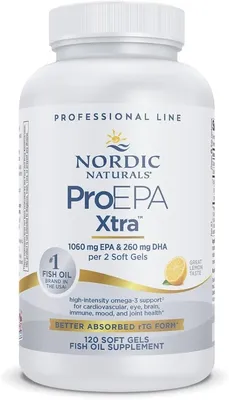
- 1,060 mg EPA per two-softgel serving — high-EPA formula for mood support
- Triglyceride form, IFOS 5-star certified
- More antidepressant evidence with high-EPA than balanced EPA/DHA
- Lemon flavor minimizes fish burps
- Premium price at about $38
- Less DHA than balanced products — not the right pick if cognitive support is also a goal
Frequently Asked Questions
How much fish oil should a man over 60 take?
Most men over 60 do well with about 1,000 mg (1 g) of combined EPA+DHA per day, the amount the American Heart Association has recommended for people with existing coronary heart disease. Read the EPA and DHA lines on the supplement facts panel and add them, rather than going by the total fish oil number on the front. Doses of 2–4 g a day are used for high triglycerides but should be supervised by your doctor.
Does fish oil cause prostate cancer?
No randomized trial has shown that fish oil causes prostate cancer. A 2013 analysis of blood samples from the SELECT trial reported that men with higher blood omega-3 levels had a 43% higher rate of prostate cancer, but that was an observational association from a single blood sample and other studies have not consistently reproduced it. If you have an elevated PSA or a family history of prostate cancer, discuss omega-3 supplements with your urologist.
Can I take fish oil with blood thinners like warfarin or apixaban?
Many men do, but not without telling their prescriber. Fish oil has a mild effect on platelet function, and Mayo Clinic notes that combining it with anticoagulants or antiplatelet drugs may increase bleeding risk. Your doctor may adjust the dose based on your overall bleeding risk and will usually ask you to pause fish oil before surgery or dental work.
Does fish oil lower blood pressure in older men?
Slightly. A 2022 dose-response meta-analysis in the Journal of the American Heart Association pooling 71 trials and 4,973 participants found that around 2–3 g a day of EPA+DHA was associated with reductions of roughly 2–3 mmHg systolic. That is a small effect, but it can add to blood-pressure medication, so monitor your home readings when you begin.
Which is better for men over 60: triglyceride or ethyl ester fish oil?
Triglyceride-form fish oil, the form found naturally in fish, tends to absorb somewhat better than the ethyl ester form used in most low-cost products. Nordic Naturals Ultimate Omega and Viva Naturals Omega-3 both use the triglyceride form; Kirkland Fish Oil uses ethyl ester. The practical difference is modest, and an ethyl ester product you take consistently beats a premium one you skip.