
AREDS 2 Without Zinc: Is There a Zinc-Free Formula, and Who Needs One?
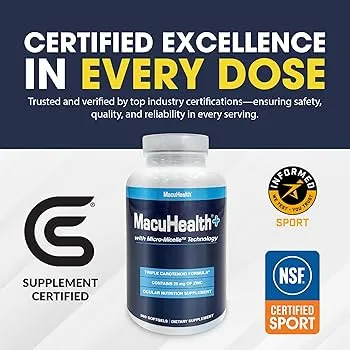
MacuHealth Plus+
The closest thing to an evidence-based low-zinc option: it uses the 25 mg zinc dose AREDS2 found comparable to 80 mg while supplying all three macular carotenoids. Best for adults over 50 who want to cut zinc without abandoning a complete formula.
- Lower 25 mg zinc dose means fewer stomach complaints than 80 mg AREDS formulas
- Supplies all three macular carotenoids — lutein, zeaxanthin and meso-zeaxanthin
- Patented formula with a clinically studied 10:10:2 carotenoid ratio
If your doctor told you to cut back on zinc — or the 80 mg dose in a standard AREDS2 pill leaves your stomach churning — you are not stuck choosing between the full formula and nothing at all. The AREDS2 trial compared 80 mg of zinc with 25 mg in a secondary randomization among a subset of its 4,203 participants, followed for a median of five years, and found no meaningful difference in how quickly macular degeneration advanced. A 25 mg low-zinc formula is the closest thing to an evidence-backed compromise, and a zinc-free carotenoid supplement is an option worth discussing with your eye doctor if zinc is off the table completely.
The Detailed Answer
Search for “AREDS 2 without zinc” and you will find plenty of eye vitamins — but almost none of them are the AREDS2 formula with the zinc removed. There is a reason for that. Zinc was never an optional extra in this research; it was one of the ingredients the trials were built around.
Here’s what the research actually shows, and what it does not.
What the AREDS2 trial actually tested about zinc
AREDS2, published in JAMA in 2013, enrolled 4,203 adults aged 50 to 85 at high risk of advanced age-related macular degeneration (AMD) and followed them for a median of five years. Alongside the main question — whether lutein and zeaxanthin could replace beta-carotene — a consenting subset of participants was also randomly assigned in a secondary comparison to the original 80 mg of zinc or a lower 25 mg dose.
The lower dose held its own. The difference between 25 mg and 80 mg in progression to advanced AMD was not statistically significant.
That is the single most useful fact for anyone worried about zinc: the choice is not 80 mg or nothing.
What no trial has tested is the formula with zinc taken out entirely. In the original AREDS (published 2001, 3,640 participants followed for an average of about six years), the treatment groups containing zinc carried most of the benefit — the antioxidant vitamins alone produced a smaller effect that did not reach statistical significance. The full combination reduced the risk of progressing to advanced AMD by about 25% over five years. So a zinc-free eye vitamin is a reasonable fallback, not an equal substitute.
Why 80 mg of zinc is a big dose
The tolerable upper intake level for zinc set by the National Institutes of Health is 40 mg a day for adults. The classic AREDS dose is double that, which is exactly why the formula also includes 2 mg of copper — sustained high-dose zinc blocks copper absorption and can lead to copper-deficiency anemia and nerve problems.
The everyday complaints are simpler: nausea, stomach upset, and a metallic taste, particularly when the pill is taken without food. In the original AREDS, participants in the zinc groups were hospitalized more often for genitourinary problems than those not taking zinc, though the reason was never fully explained. Our guide to AREDS 2 side effects and who should not take PreserVision covers those tolerance issues in more detail.
Who has a real reason to avoid or lower zinc
- Advanced chronic kidney disease or dialysis. Mineral balance is managed carefully in kidney disease, and supplement recommendations differ from person to person. This is a nephrologist question, not a shelf-label question.
- Known copper deficiency, or a history of gastric bypass or other bariatric surgery, where copper absorption is already compromised.
- Persistent stomach upset on the full-strength formula — a common reason people stop taking it.
- Stacking. If you also take a multivitamin, a prostate formula, or an immune supplement with zinc, your daily total may quietly climb past 100 mg.
- Certain medications. Zinc can reduce absorption of tetracycline and quinolone antibiotics and of penicillamine; these are usually separated by a few hours rather than avoided outright. Ask your pharmacist how to space them.
What to take instead: lower the zinc, or skip it
| Option | Zinc | Carotenoids | Site-stated price |
|---|---|---|---|
| MacuHealth Plus+ (low-zinc) | 25 mg | Lutein, zeaxanthin and meso-zeaxanthin in a patented 10:10:2 ratio | About $45 for a 90-day supply |
| Pure Encapsulations Lutein/Zeaxanthin (zinc-free) | None — a two-ingredient product | Lutein 10 mg, zeaxanthin 2 mg | About $35 |
MacuHealth Plus+ uses the 25 mg zinc dose that AREDS2 found comparable to 80 mg, and it supplies all three macular carotenoids — lutein, zeaxanthin and meso-zeaxanthin — at that lower zinc level; our reviewers rate it 4.6 out of 5. It is not cheap, and it has less AMD-specific outcome evidence than the AREDS2 formula itself — a fair trade-off only you and your eye doctor can weigh. Full details are in our MacuHealth Plus+ review.
If zinc is off the table completely, Pure Encapsulations Lutein/Zeaxanthin is the cleanest zinc-free choice: hypoallergenic, third-party tested, GMP-certified, and just the two carotenoids at AREDS2 doses. Because it contains no vitamin C, vitamin E, or copper, it works best layered on top of a quality multivitamin rather than as a stand-alone replacement for the AREDS2 formula.
Purpose-made zinc-free macular formulas also exist, sold mostly through eye-care practices rather than store shelves. If your eye doctor suggests one, read its Supplement Facts panel yourself before buying — “low zinc” and “zinc free” get used loosely on front labels, and the panel is the only place the actual milligrams appear.
Related Questions
Is AREDS2 safe for your kidneys?
There is no evidence that the AREDS2 formula damages healthy kidneys, and zinc is cleared mostly through the digestive tract rather than the kidneys. The caution applies to people who already have chronic kidney disease, where mineral levels and supplement use are managed individually — high-dose zinc and vitamin C in particular deserve a conversation with your nephrologist. Do not stop a supplement your ophthalmologist prescribed without telling both doctors.
Do zinc-free eye vitamins still slow macular degeneration?
Honestly, we don’t know. Lutein and zeaxanthin raise macular pigment density, and AREDS2 showed benefit for the formula that contained them alongside zinc — but the AREDS trials never tested the carotenoids without zinc, so there is no direct trial answer for AMD progression. If you can tolerate 25 mg of zinc, the evidence favors keeping it; if you cannot, a carotenoid-only product is a reasonable second choice rather than an equivalent one.
Do I still need copper if I take a low-zinc or zinc-free formula?
The 2 mg of copper in the AREDS formula is there to offset copper losses caused by 80 mg of zinc. At 25 mg of zinc the risk of copper depletion is much lower, and with no zinc at all, added copper is not needed for that reason. If you are switching formulas, check that you are not doubling up on copper from a multivitamin as well.
Can I just take the AREDS2 pill every other day to cut the zinc?
Splitting or skipping doses lowers everything in the formula, not just the zinc, and it has never been studied. A purpose-made 25 mg zinc product keeps the other ingredients at tested amounts. Our full breakdown of the AREDS 2 formula and its alternatives shows what each ingredient contributes.
When to Talk to Your Doctor
Eye supplements look like an ordinary shelf purchase, but the AREDS2 formula is closer to a prescribed dose than a daily multivitamin, and switching away from it is a medical decision. Consult your doctor, ophthalmologist, or pharmacist before you change formulas — especially in these situations:
- You have intermediate or advanced AMD in one or both eyes. Your retina specialist chose the formula for a reason and should know if you are lowering the zinc.
- You have chronic kidney disease, are on dialysis, or have had bariatric surgery. Mineral dosing needs to be individualized.
- You take tetracycline or quinolone antibiotics, penicillamine, or a thiazide diuretic (which changes how much zinc your body keeps). Timing and monitoring may need adjusting.
- You are a current or former smoker. This affects beta-carotene, not zinc — but it remains the single most important AREDS-related safety question to raise.
- The pills upset your stomach. Say so. Stomach upset is a common reason people abandon a formula that was helping them, and a lower-zinc version or taking it with a full meal often solves it.
Bring the actual bottles to your next appointment, including your multivitamin, so the total daily zinc from every source can be added up. The bottom line: aim to reduce zinc thoughtfully rather than eliminate it by guesswork.
Sources:
- AREDS2 Research Group. Lutein + Zeaxanthin and Omega-3 Fatty Acids for Age-Related Macular Degeneration (JAMA, 2013) — Source for the 4,203 participants, median five-year follow-up, and the secondary randomization comparing 80 mg and 25 mg zinc.
- AREDS Report No. 8: A Randomized, Placebo-Controlled Clinical Trial of High-Dose Supplementation With Vitamins C and E, Beta Carotene, and Zinc (Arch Ophthalmol, 2001) — Source for 3,640 participants, the roughly 25% reduction in progression to advanced AMD, the weaker antioxidant-only effect, and genitourinary hospitalizations in zinc groups.
- National Eye Institute — Age-Related Eye Disease Studies (AREDS/AREDS2) — Source for the AREDS2 formulation contents, including 80 mg zinc and 2 mg copper.
- NIH Office of Dietary Supplements — Zinc Fact Sheet for Health Professionals — Source for the 40 mg/day tolerable upper intake level, copper-deficiency risk, zinc’s primarily fecal (digestive-tract) excretion, and interactions with tetracycline and quinolone antibiotics, penicillamine, and thiazide diuretics.
- American Academy of Ophthalmology — AREDS2 Supplements for Age-Related Macular Degeneration — General clinical guidance on who benefits from AREDS2 supplementation.
Products We Recommend
- Lower 25 mg zinc dose means fewer stomach complaints than 80 mg AREDS formulas
- Supplies all three macular carotenoids — lutein, zeaxanthin and meso-zeaxanthin
- Patented formula with a clinically studied 10:10:2 carotenoid ratio
- Backed by published research from the Waterford Institute of Technology
- Premium price at roughly $45 for a 90-day supply
- Less clinical evidence than AREDS2 for slowing AMD progression specifically
- Limited retail availability — primarily online or through eye care professionals
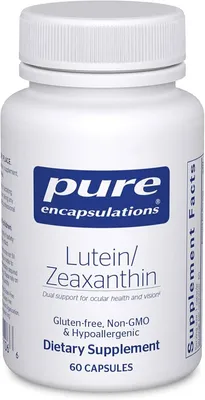
- Contains no zinc, copper, or other minerals — a two-ingredient product
- Lutein 10 mg and zeaxanthin 2 mg, matching AREDS2 carotenoid doses
- Hypoallergenic — no gluten, soy, dairy, GMOs, or additives
- Third-party tested and GMP-certified
- No AREDS2 vitamins or minerals, so it is incomplete on its own
- Not tested on its own for AMD progression in the AREDS trials
- Premium price at about $35 for a two-ingredient product
Frequently Asked Questions
Is there a PreserVision alternative without zinc?
PreserVision's standard AREDS 2 products all include zinc, so there is no version of that formula with the zinc simply removed. The practical alternatives are a lower-zinc formula at 25 mg, the dose AREDS2 found comparable to 80 mg, a zinc-free macular formula sold through eye-care practices (verify the Supplement Facts panel yourself), or a stand-alone carotenoid supplement such as Pure Encapsulations Lutein/Zeaxanthin, which contains lutein 10 mg and zeaxanthin 2 mg and no other vitamins or minerals. Ask your eye doctor which trade-off fits your risk level.
How much zinc per day is too much?
The National Institutes of Health sets the tolerable upper intake level for zinc at 40 mg a day for adults. The classic AREDS formula uses 80 mg under medical supervision, which is why it also includes 2 mg of copper to offset copper depletion. Add up zinc from every supplement you take, since many multivitamins and immune formulas contain zinc of their own.
How do I know how much zinc my eye supplement contains?
Look at the Supplement Facts panel, not the front label, and find the line reading "Zinc (as zinc oxide)" or a similar form with the milligram amount. Anything listed only inside a "proprietary blend" hides the individual doses, which is a reason to choose a different product. Third-party verification such as USP, NSF, or ConsumerLab testing adds confidence that the label matches the capsule.
Can I get enough lutein and zeaxanthin from food instead of a supplement?
Kale, spinach, collard greens, corn, and egg yolks are the richest dietary sources, and a diet consistently high in leafy greens is associated with better macular pigment levels. Reaching the 10 mg of lutein used in AREDS2 through food alone takes a large, daily serving of cooked greens, which is why supplements were tested in the first place. Food and supplements are not mutually exclusive — discuss the combination with your doctor.