
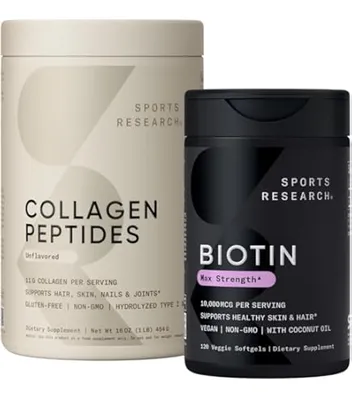
Sports Research Collagen Peptides (Unflavored)
Best collagen powder for daily use — high quality grass-fed source, dissolves cleanly, and is third-party certified. An easy add to your morning coffee or smoothie.
- Hydrolyzed type I & III collagen from grass-fed bovine
- 11g per scoop
- Dissolves easily in hot or cold liquids
- Third-party certified (Informed Sport)
- Unflavored and versatile
- Large tub (may be intimidating for first-time users)
- Grass-fed sourcing costs more
- Collagen evidence for skin is moderate (not conclusive)
Sports Research Collagen Peptides is our top pick for a daily collagen powder. It dissolves completely, tastes like nothing, and delivers 11g of grass-fed hydrolyzed collagen per scoop with Informed Sport third-party certification. If you want to add collagen to your routine without changing how your coffee or smoothie tastes, this is the one.
What Is It?
Sports Research Collagen Peptides is a hydrolyzed collagen powder made from the hides of grass-fed, pasture-raised cattle. “Hydrolyzed” means the collagen proteins have been broken down into small peptides that dissolve easily and absorb efficiently in your digestive system.
It provides type I and type III collagen — the two types most abundant in skin, bones, tendons, and connective tissue. Type I makes up roughly 90% of the collagen in your body and is the primary type associated with skin elasticity and bone strength.
The product is Informed Sport certified, meaning every production batch is independently tested for banned substances, heavy metals, and contaminants.
What’s Inside
Each scoop (one serving) provides:
- 11g hydrolyzed collagen peptides — from grass-fed, pasture-raised bovine hide
- Type I and Type III collagen — the most relevant types for skin, hair, nails, bones, and joints
- Key amino acids: glycine, proline, and hydroxyproline — the building blocks your body uses to synthesize new collagen
That’s it. No added sugars, flavors, sweeteners, fillers, or excipients. The ingredient list is literally one item: hydrolyzed bovine collagen peptides.
What the Research Says
Hydrolyzed collagen peptides have a growing body of clinical evidence, though the field is still maturing.
For skin health, a 2019 meta-analysis in the Journal of Drugs in Dermatology covering 11 studies and over 800 participants found that collagen supplementation improved skin elasticity, hydration, and dermal collagen density compared to placebo. Benefits appeared after 4-12 weeks of daily use at 2.5-10g.
For joint comfort, a 2018 study in Applied Physiology, Nutrition, and Metabolism found that 5g of collagen peptides daily for 12 weeks reduced activity-related joint pain in physically active adults. A 2017 study in the British Journal of Sports Medicine reported similar results.
For bone density, a 2018 study in Nutrients found that 5g of specific collagen peptides daily for 12 months increased bone mineral density in postmenopausal women — a particularly relevant finding for women over 50 experiencing age-related bone loss.
It’s worth noting that collagen is not a complete protein (it lacks tryptophan) and should not replace your protein intake. Think of it as a targeted supplement for connective tissue, not a general protein source.
Who Is This Best For?
Sports Research Collagen Peptides is ideal if you:
- Want an easy daily collagen supplement you can add to coffee, tea, or smoothies
- Are looking for skin, hair, and nail support after 50
- Want joint comfort support alongside (not instead of) a dedicated joint supplement
- Prefer a clean, unflavored product with no additives
- Value third-party testing and grass-fed sourcing
This may not be ideal if you’re looking for joint-specific collagen (UC-II type II collagen works through a different, more targeted mechanism), need a vegan/vegetarian option (this is bovine-sourced), or want a flavored product that doubles as a drink on its own.
How to Take It
Add one scoop (11g) to any hot or cold beverage and stir. It dissolves within 15-20 seconds in hot liquids and slightly longer in cold ones. Most people add it to:
- Morning coffee or tea (most popular)
- Smoothies or protein shakes
- Oatmeal or yogurt
- Soups or broths
Timing doesn’t matter much. Consistency matters far more than when you take it. Pick a daily habit you already have (morning coffee is ideal) and attach your collagen to it.
For enhanced results, consider pairing with vitamin C — your body needs vitamin C to synthesize collagen. A glass of orange juice, a handful of berries, or a vitamin C supplement alongside your collagen can support the process.
Give it at least 8-12 weeks of daily use before evaluating results. Collagen turnover in your body is slow, and the visible benefits are gradual.
The Bottom Line
At $33 for approximately 41 servings, Sports Research Collagen Peptides costs roughly $0.80 per day. That’s a reasonable investment for a product that is grass-fed sourced, third-party certified, and genuinely unflavored.
The evidence for hydrolyzed collagen is moderate but growing — strongest for skin elasticity and hydration, promising for joint comfort and bone density. This product makes it as easy as possible to be consistent: one scoop in your coffee, no taste, no hassle, and you’re done.
If you’ve been curious about collagen but don’t want to deal with pills, chalky powders, or weird flavors, this is the place to start.
As with any supplement, consult your healthcare provider before starting collagen peptides, especially if you have food allergies (bovine source) or are on a restricted diet.
Frequently Asked Questions
Does collagen powder actually work for skin after 50?
The evidence is encouraging. A 2019 meta-analysis of 11 randomized controlled trials found that hydrolyzed collagen peptides significantly improved skin elasticity, hydration, and wrinkle appearance compared to placebo. Most studies used 5-10g daily for 8-12 weeks. Results are modest — collagen won't reverse decades of aging — but many users over 50 report noticeably smoother, more hydrated skin with consistent use.
How much collagen should I take per day?
For general skin, hair, nail, and joint benefits, 10-15g of hydrolyzed collagen peptides daily is well-supported by research. Sports Research provides 11g per scoop, which falls squarely in the effective range. Some studies show benefits starting at 5g, but higher doses (10-15g) tend to show more consistent results across skin, joint, and bone endpoints.
Can I put collagen peptides in coffee?
Yes, and it's the most popular way people take it. Sports Research Collagen Peptides dissolves completely in hot coffee without changing the taste, texture, or smell. It also works in cold beverages, smoothies, oatmeal, soup, or baked goods. Heat does not destroy hydrolyzed collagen — the peptides are already broken down and remain stable at cooking temperatures.
What does 'Informed Sport certified' mean?
Informed Sport is a globally recognized third-party testing and certification program. Every batch is tested for over 250 banned substances, heavy metals, and contaminants. This certification is primarily used by athletes, but for consumers it provides an extra layer of assurance that what's on the label is actually in the product — and nothing harmful is hiding inside.
Is grass-fed collagen really better?
Grass-fed, pasture-raised sourcing means the cattle were raised without routine antibiotics or added hormones, with access to pasture. Whether this produces a measurably superior collagen peptide is debated — the hydrolysis process breaks collagen down to the same amino acid chains regardless of source. However, grass-fed sourcing avoids potential contaminant exposure and aligns with higher animal welfare standards. For many buyers, it's a quality signal worth the modest price premium.