
Calcium Citrate vs Calcium Carbonate: Which Is Better for Adults Over 50?
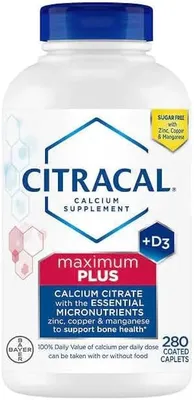
Citracal Maximum Plus D3
Best calcium citrate — the top choice for adults over 50, especially those on acid reflux medications.
- Calcium citrate — absorbs with or without food
- Includes 500 IU vitamin D3 per serving for enhanced absorption
- Recommended by gastroenterologists for patients on PPIs
For most adults over 50, calcium citrate is the better choice for bone health supplementation. It absorbs reliably with or without food, does not depend on stomach acid, and causes fewer digestive side effects than calcium carbonate. This distinction becomes increasingly important with age — stomach acid production naturally declines after 50, and millions of older adults take proton pump inhibitors (PPIs) or antacids that further reduce acid levels. Calcium carbonate needs that acid to dissolve and absorb properly. Calcium citrate does not.
We reviewed the absorption research, compared GI side effect profiles, and evaluated three widely available products to help you choose the right form of calcium for your bones.
What Is Calcium Carbonate?
Calcium carbonate is the most common and least expensive form of supplemental calcium. It is found in natural sources like limestone, marble, and oyster shells. Many over-the-counter antacids (like Tums) are essentially calcium carbonate tablets — which is how many people inadvertently get their calcium.
Calcium carbonate contains 40% elemental calcium by weight — the highest concentration of any common calcium supplement form. This means a 1,250mg calcium carbonate tablet delivers 500mg of actual usable calcium. Fewer tablets are needed to reach your daily target, which is a genuine convenience advantage.
How Calcium Carbonate Works
When you swallow calcium carbonate, it needs to dissolve before your body can absorb the calcium. This dissolution depends heavily on stomach acid. Hydrochloric acid in your stomach breaks down the carbonate salt, releasing free calcium ions that your small intestine can absorb.
This acid dependency is the central issue for older adults. Research shows that stomach acid production (and the related ability to dissolve calcium carbonate) declines meaningfully after age 50. A 1999 study by Recker demonstrated that calcium carbonate absorption drops significantly in people with reduced stomach acid (achlorhydria), while calcium citrate absorption remains steady regardless of stomach acid levels.
The Antacid Effect
Calcium carbonate’s alkalizing property is a double-edged sword. It neutralizes stomach acid, which is why it works as an antacid. But this same property can:
- Cause rebound acid production in some people
- Reduce absorption of other nutrients and medications taken at the same time
- Contribute to gas, bloating, and constipation — the most common complaints with calcium carbonate supplements
If you take calcium carbonate, always take it with a meal. Food stimulates stomach acid production, improving dissolution and absorption. Taking calcium carbonate on an empty stomach significantly reduces how much calcium your body actually gets.
What Is Calcium Citrate?
Calcium citrate is calcium bound to citric acid. It is the form most commonly recommended by gastroenterologists and geriatricians for adults over 50. Citracal is the best-known brand, though many manufacturers offer calcium citrate products.
Calcium citrate contains 21% elemental calcium by weight — about half the concentration of calcium carbonate. A 1,000mg calcium citrate tablet delivers only 210mg of elemental calcium. This means you need roughly twice as many tablets to get the same amount of calcium, which increases pill burden and typically raises the per-tablet cost.
How Calcium Citrate Works
Unlike calcium carbonate, calcium citrate is already in an acidic salt form. It dissolves readily in water and does not require stomach acid to break down. This is the pharmacological foundation for its advantage in older adults.
When calcium citrate reaches your small intestine, the calcium is already in a soluble, absorbable form — regardless of how much (or how little) stomach acid you produce. This means:
- Absorption is consistent whether you take it with or without food
- PPIs, H2 blockers, and antacids do not impair its absorption
- People with atrophic gastritis (age-related stomach lining thinning, common after 65) absorb it normally
- The citrate component may itself have a modest alkalizing effect on urine, potentially reducing kidney stone risk
Fewer Digestive Side Effects
Calcium citrate does not have the antacid effect of calcium carbonate. It does not alter stomach pH significantly, does not cause the same gas and bloating, and is less likely to cause constipation. For adults who have tried calcium carbonate and experienced GI discomfort, switching to citrate often resolves the problem.
Head-to-Head: The Evidence Compared
Absorption: The Heaney Studies
Robert Heaney’s research group at Creighton University conducted some of the most important calcium absorption studies. A 2001 study published in the Journal of the American College of Nutrition compared calcium citrate and calcium carbonate absorption under controlled conditions.
Key finding: When taken with food, calcium citrate and calcium carbonate absorbed at similar rates in healthy adults with normal stomach acid. However, when taken without food — or in people with reduced stomach acid — calcium citrate showed significantly better absorption. The authors estimated calcium citrate was approximately 22-27% better absorbed than calcium carbonate on an empty stomach.
This finding explains why calcium carbonate can work fine for younger adults who take it with meals and have robust acid production — but becomes progressively less reliable as stomach acid declines with age.
PPI Users: The Acid Suppression Problem
A large proportion of adults over 50 take PPIs (omeprazole, esomeprazole, lansoprazole, pantoprazole) for acid reflux, GERD, or ulcer prevention. PPIs reduce stomach acid production by 90-95% — and they are often taken for years or even decades.
A 2005 study by O’Connell et al. published in the Journal of Clinical Endocrinology and Metabolism found that fracture risk increased with prolonged PPI use, partly due to impaired calcium absorption. Research by Straub et al. confirmed that acid suppression significantly reduces calcium carbonate absorption.
The practical takeaway: If you take a PPI daily, calcium carbonate is a poor choice. Your stomach simply does not produce enough acid to dissolve it effectively. Calcium citrate sidesteps this problem entirely.
The Cardiovascular Question: The Bolland Meta-Analysis
A 2010 meta-analysis by Bolland et al. published in the BMJ raised concerns about calcium supplements and cardiovascular risk. The analysis of 15 trials found that calcium supplementation (without co-administered vitamin D) was associated with approximately a 30% increase in heart attack risk.
This finding remains controversial. Subsequent analyses have produced mixed results, and major medical organizations have not changed their calcium recommendations based on this study alone. However, the Bolland analysis reinforced an important principle: more calcium is not better. Taking calcium supplements on top of an already calcium-rich diet can push total intake above 1,200mg daily, which is where any potential risk may begin.
The safest approach, supported by most current guidelines:
- Get most of your calcium from food (dairy, fortified plant milks, sardines, tofu, leafy greens)
- Supplement only the gap between your dietary intake and the 1,000-1,200mg daily target
- Always take calcium with vitamin D, which improves absorption and may offset cardiovascular concerns
- Split your dose — your body absorbs calcium more efficiently in amounts of 500mg or less at a time
What the Evidence Tells Us
| Factor | Calcium Carbonate | Calcium Citrate |
|---|---|---|
| Elemental calcium per tablet | 40% (high — fewer tablets needed) | 21% (low — more tablets needed) |
| Requires stomach acid | Yes — must take with food | No — absorbs with or without food |
| Absorption in older adults | Reduced as stomach acid declines | Consistent regardless of acid levels |
| Affected by PPIs/antacids | Yes — significantly reduced | No — unaffected |
| GI side effects | More common (gas, bloating, constipation) | Less common — generally better tolerated |
| Cost | Lowest — roughly $0.05-0.15/day | Moderate — roughly $0.15-0.30/day |
| Tablet size | Smaller (more calcium per tablet) | Larger or more tablets per serving |
| Antacid effect | Yes — neutralizes stomach acid | Minimal |
When to Choose Calcium Carbonate
Calcium carbonate is a reasonable choice if:
You are under 50 with strong stomach acid. If you are relatively young, have no digestive issues, and produce normal amounts of stomach acid, calcium carbonate absorbs adequately when taken with meals. The cost savings and lower pill count are genuine advantages.
Budget is your primary concern. Calcium carbonate is the cheapest supplemental calcium available. Nature Made Calcium 600+D3 costs roughly $0.10 per day — a fraction of calcium citrate options. If cost is the deciding factor and you can consistently take it with meals, carbonate delivers adequate calcium at the lowest price.
You already tolerate it well. If you have been taking calcium carbonate for years without constipation, gas, or bloating, and your bone density scans show stable or improving results, there may be no reason to switch. The best supplement is one you actually take consistently.
You only need a small supplemental dose. If your diet is already rich in calcium and you just need an extra 200-300mg, a single calcium carbonate tablet with dinner may be the simplest approach.
Important rule: Always take calcium carbonate with a meal — ideally your largest meal of the day, when stomach acid production is at its peak.
When to Choose Calcium Citrate
Calcium citrate is the better choice if:
You are over 50. Stomach acid production declines with age, and this decline accelerates after 65. Even if you feel fine digestively, your calcium carbonate absorption may be lower than you think. Calcium citrate removes the guesswork by absorbing consistently at any acid level.
You take a PPI, H2 blocker, or antacid regularly. Medications like omeprazole (Prilosec), famotidine (Pepcid), or even over-the-counter Tums reduce the stomach acid that calcium carbonate needs. If any acid-reducing medication is part of your daily routine, calcium citrate is strongly recommended.
You experience gas, bloating, or constipation with calcium carbonate. GI side effects are the number one reason people stop taking calcium supplements. If carbonate bothers your stomach, switching to citrate typically resolves the issue — and a supplement you actually take every day is more valuable than one gathering dust in your medicine cabinet.
You prefer flexibility in timing. Calcium citrate can be taken with or without food, at any time of day. If remembering to take supplements with meals is a challenge, citrate gives you more flexibility.
You have been diagnosed with low stomach acid (hypochlorhydria) or atrophic gastritis. These conditions, common in adults over 65, significantly impair calcium carbonate absorption. Calcium citrate is the standard recommendation from gastroenterologists for these patients.
Getting the Most From Your Calcium Supplement
Regardless of which form you choose, these evidence-based practices improve your results:
Always take calcium with vitamin D. Vitamin D is essential for calcium absorption in the small intestine. Without adequate vitamin D, even perfectly dissolved calcium passes through your body unused. Most calcium supplements now include vitamin D3 — look for at least 400-800 IU per serving. Many adults over 50 need 1,000-2,000 IU of vitamin D3 daily in total.
Split your dose. Your body absorbs calcium most efficiently in amounts of 500mg or less at one time. If you need 600mg daily from supplements, take 300mg in the morning and 300mg in the evening rather than all at once.
Space calcium away from certain medications. Calcium can interfere with the absorption of thyroid medication (levothyroxine), certain antibiotics (tetracyclines, quinolones), and bisphosphonates (alendronate, risedronate). Separate calcium from these medications by at least 2-4 hours. Your pharmacist can help you plan a schedule.
Do not exceed 1,000-1,200mg total daily calcium. This includes calcium from food. If your diet provides 700mg of calcium daily (typical for someone who eats dairy), you only need 300-500mg from a supplement. More is not better and may carry risks.
Consult your doctor about your specific calcium needs, especially if you have a history of kidney stones, take blood thinners, or have been diagnosed with osteoporosis. Your doctor may recommend a bone density scan to guide supplementation decisions.
Our Product Recommendations
Citracal Maximum Plus D3 — Best Calcium Citrate
Citracal is the best-known calcium citrate brand for good reason — it is the form most frequently recommended by gastroenterologists for patients on acid-reducing medications. Each two-tablet serving delivers 315mg of elemental calcium plus 500 IU of vitamin D3.
The tablets are on the larger side, which some people find difficult to swallow. If this is a concern, Citracal also makes a smaller “Petites” version with a lower dose per tablet.
Who it’s best for: Adults over 50, especially those on PPIs or antacids, who want the most established calcium citrate product with vitamin D included. Read our full review: Citracal Maximum Plus D3
Nature Made Calcium 600+D3 — Best Budget Calcium Carbonate
Nature Made earns the USP Verified mark — meaning an independent lab has confirmed that the product contains what the label claims, dissolves properly, and is free from harmful contaminants. At roughly $0.10 per day, it is the most affordable calcium supplement on this list.
The 600mg elemental calcium per tablet is a high single dose. If you use this product, consider splitting the tablet or taking it with your largest meal to maximize absorption and minimize GI side effects.
Who it’s best for: Budget-conscious adults under 50 with good stomach acid production and no digestive complaints — or anyone who has been taking calcium carbonate successfully and sees no reason to switch. Read our full review: Nature Made Calcium 600+D3
Garden of Life Plant Calcium — Best Plant-Based Alternative
Garden of Life takes a different approach — algae-derived calcium (from the sea plant Lithothamnion) in a USDA Organic, vegan formula. Beyond calcium, it includes vitamin D3, vitamin K2 (which directs calcium to bones and away from arteries), magnesium, and trace minerals from the whole-food algae source.
The comprehensive formula and whole-food sourcing come at a higher price — roughly three times the cost of Nature Made per serving. The three-tablet serving also adds pill burden.
Who it’s best for: Adults who prefer plant-based, whole-food supplements and want a comprehensive bone support formula that goes beyond calcium alone. The added K2 and magnesium are meaningful bone health ingredients that most calcium-only products lack. Read our full review: Garden of Life Plant Calcium
Frequently Asked Questions
Can I take calcium citrate on an empty stomach? Yes — calcium citrate absorbs well with or without food because it does not need stomach acid to dissolve. This is one of its key advantages over calcium carbonate, which must be taken with meals. Taking calcium citrate on an empty stomach is especially convenient if you prefer to separate it from other supplements or medications that interact with calcium (like thyroid medication or certain antibiotics). Taking it with food is also fine and will not reduce absorption.
How much calcium should adults over 50 take daily? The National Institutes of Health recommends 1,000mg of total calcium daily for men aged 51-70 and 1,200mg daily for women over 50 and men over 70. This includes calcium from food sources — dairy products, fortified foods, leafy greens, and canned fish with bones. Most adults get 600-900mg from their diet, so a supplement of 300-600mg typically fills the gap. Do not exceed 1,200mg total daily calcium (diet plus supplements) without your doctor’s guidance, as excess calcium may carry cardiovascular and kidney stone risks.
Does calcium carbonate cause more constipation than calcium citrate? Yes, calcium carbonate is more likely to cause constipation, gas, and bloating than calcium citrate. This is partly because calcium carbonate has an antacid effect that alters gut pH and slows digestion, and partly because the higher elemental calcium per tablet means a larger single dose hitting your digestive system at once. Calcium citrate is generally better tolerated. If you experience constipation with calcium carbonate, switching to calcium citrate — or splitting your dose into smaller amounts taken throughout the day — often resolves the issue.
Can I take calcium if I take a proton pump inhibitor (PPI)? Yes, but choose calcium citrate. PPIs like omeprazole (Prilosec) and esomeprazole (Nexium) significantly reduce stomach acid production, which impairs calcium carbonate absorption. Research has shown that PPIs can meaningfully reduce calcium carbonate absorption. Calcium citrate does not depend on stomach acid, so its absorption is not affected by PPIs. If you take a PPI daily, calcium citrate is the strongly preferred form.
Is too much calcium dangerous? Taking more calcium than your body needs does not build stronger bones — and may carry risks. A 2010 meta-analysis by Bolland et al. published in the BMJ found a potential association between calcium supplements (without co-administered vitamin D) and increased cardiovascular events, though this remains debated. Excessive calcium may also increase kidney stone risk in susceptible individuals. The safest approach is to get most of your calcium from food, supplement only the gap, and always take calcium with vitamin D.
The Bottom Line
For adults over 50, calcium citrate is generally the better form. It absorbs reliably regardless of stomach acid levels, causes fewer digestive side effects, and is unaffected by the acid-reducing medications that millions of older adults take daily. The trade-offs — higher cost per serving and more tablets needed — are worth it for the improved absorption and tolerability.
Calcium carbonate remains a reasonable option for younger adults with healthy digestion and tight budgets, or for anyone who has been using it successfully without issues.
Whichever form you choose, remember three principles: always pair calcium with vitamin D, do not exceed 1,000-1,200mg total daily calcium from all sources, and split your dose to absorb more efficiently. Your bones will thank you.
For related reading, see our guides on Best Bone Health Supplements, Do Calcium Supplements Cause Kidney Stones?, Calcium and Vitamin D for Bone Health, and Osteoporosis Prevention After 50.
All Products We Reviewed
- Calcium citrate — absorbs with or without food
- Includes 500 IU vitamin D3 per serving for enhanced absorption
- Recommended by gastroenterologists for patients on PPIs
- Well-tolerated with fewer GI side effects than carbonate forms
- Tablets are large — may be difficult for some to swallow
- 21% elemental calcium means more tablets needed to reach target dose
- Contains only 315mg elemental calcium per two-tablet serving

- USP Verified — independent testing for purity and potency
- 600mg elemental calcium per tablet (high per-tablet dose)
- Includes 400 IU vitamin D3
- Most affordable option at roughly $0.10/day
- Calcium carbonate — must be taken with food for proper absorption
- More likely to cause constipation, gas, and bloating
- Not ideal for people on PPIs or antacids

- USDA Organic, whole-food algae-derived calcium
- Includes vitamin D3, vitamin K2, magnesium, and trace minerals
- Plant-based and vegan-friendly
- Comprehensive bone support formula beyond just calcium
- Significantly more expensive per serving
- Three tablets per serving — higher pill burden
- Lower elemental calcium per serving than carbonate products
Frequently Asked Questions
Can I take calcium citrate on an empty stomach?
Yes — calcium citrate absorbs well with or without food because it does not need stomach acid to dissolve. This is one of its key advantages over calcium carbonate, which must be taken with meals to ensure adequate stomach acid for absorption. Taking calcium citrate on an empty stomach is especially convenient if you prefer to separate it from other supplements or medications that interact with calcium (like thyroid medication or certain antibiotics). That said, taking it with food is also fine and will not reduce absorption.
How much calcium should adults over 50 take daily?
The National Institutes of Health recommends 1,000mg of total calcium daily for men aged 51-70 and 1,200mg daily for women over 50 and men over 70. This includes calcium from food sources — dairy products, fortified foods, leafy greens, and canned fish with bones. Most adults get 600-900mg from their diet, so a supplement of 300-600mg typically fills the gap. Do not exceed 1,200mg total daily calcium (diet plus supplements) without your doctor's guidance, as excess calcium may carry cardiovascular and kidney stone risks.
Does calcium carbonate cause more constipation than calcium citrate?
Yes, calcium carbonate is more likely to cause constipation, gas, and bloating than calcium citrate. This is partly because calcium carbonate has an antacid effect that alters gut pH and slows digestion, and partly because the higher elemental calcium per tablet means a larger single dose hitting your digestive system at once. Calcium citrate is generally better tolerated. If you experience constipation with calcium carbonate, switching to calcium citrate — or splitting your dose into smaller amounts taken throughout the day — often resolves the issue.
Can I take calcium if I take a proton pump inhibitor (PPI)?
Yes, but choose calcium citrate. PPIs like omeprazole (Prilosec) and esomeprazole (Nexium) significantly reduce stomach acid production, which impairs calcium carbonate absorption. A study by Straub et al. found that PPIs can reduce calcium carbonate absorption by up to 50% in some patients. Calcium citrate does not depend on stomach acid, so its absorption is not affected by PPIs. If you take a PPI daily, calcium citrate is the strongly preferred form for bone health supplementation.
Is too much calcium dangerous?
Taking more calcium than your body needs does not build stronger bones — and may carry risks. A 2010 meta-analysis by Bolland et al. published in the BMJ found a potential association between calcium supplements (without co-administered vitamin D) and increased cardiovascular events, though this remains debated among researchers. Excessive calcium intake may also increase the risk of kidney stones in susceptible individuals. The safest approach is to get most of your calcium from food and supplement only the gap between your dietary intake and the recommended 1,000-1,200mg daily total. Always take calcium with vitamin D, which improves absorption and may offset some of the concerns raised in the Bolland analysis.