
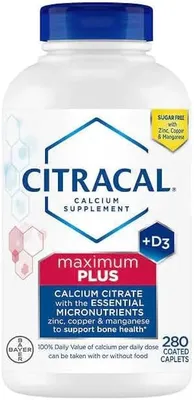
Citracal Maximum Plus D3
Best calcium supplement for anyone on acid-reducing medications — calcium citrate's food-independent absorption makes it the gastroenterologist-preferred choice for adults over 50.
- Calcium citrate absorbs without food and without stomach acid
- Ideal for people taking PPIs or H2 blockers
- 500 IU vitamin D3 per serving — more than most calcium supplements
- Trusted Bayer pharmaceutical brand
- Requires two caplets per serving (vs one tablet for carbonate options)
- Higher cost per serving than calcium carbonate alternatives
- Caplets are fairly large — may be difficult for some to swallow
Citracal Maximum Plus D3 is the best calcium citrate supplement for adults over 50, delivering 630mg of calcium citrate plus 500 IU of vitamin D3 in a formula that absorbs with or without food. For the millions of seniors who take acid-reducing medications like omeprazole or famotidine, this is the calcium supplement that gastroenterologists actually recommend — because calcium citrate doesn’t need stomach acid to work.
What Is Citracal Maximum Plus D3?
Citracal is made by Bayer, one of the oldest and most established pharmaceutical companies in the world. The brand has been synonymous with calcium citrate supplementation for decades, and it’s the calcium product most frequently recommended by gastroenterologists and pharmacists who understand the absorption differences between calcium forms.
The “Maximum Plus” formula provides the highest amount of calcium citrate per serving in the Citracal line, paired with 500 IU of vitamin D3 — more D3 than most calcium supplements include. It’s designed as a once-daily bone health regimen in a two-caplet serving.
What’s Inside
Each two-caplet serving delivers:
- Calcium (630mg as calcium citrate) — 48% of the daily value for adults over 50
- Vitamin D3 (500 IU / 12.5mcg) — supports calcium absorption and bone metabolism
- Zinc (7.5mg), Copper (1mg), Manganese (1.8mg) — trace minerals that support bone matrix formation
Calcium citrate provides 21% elemental calcium by weight — lower than calcium carbonate’s 40%. This means the tablets need to be larger or more numerous to deliver the same calcium dose. It’s the trade-off for significantly better absorption characteristics.
The formula includes no artificial flavors or preservatives. Inactive ingredients include croscarmellose sodium, polyethylene glycol, titanium dioxide (coating), and magnesium stearate.
What the Research Says
The absorption advantage of calcium citrate is well-documented. A study published in the Journal of Clinical Pharmacology found that calcium citrate was absorbed 22-27% better than calcium carbonate when taken on an empty stomach. When taken with food, the difference narrows — but for anyone taking acid-reducing medications, the with-food scenario doesn’t fix calcium carbonate’s fundamental problem.
This matters enormously for adults over 50. A study in Archives of Internal Medicine estimated that 15-20% of adults over 60 take proton pump inhibitors (PPIs) regularly. Research published in Osteoporosis International (2015) demonstrated that long-term PPI use is associated with a 30-40% increased risk of hip fracture — partly because PPIs reduce calcium carbonate absorption. Calcium citrate bypasses this issue entirely.
A meta-analysis in JAMA Internal Medicine (2015) reviewing calcium supplementation and fracture risk found that calcium plus vitamin D reduced hip fracture risk by approximately 30% in institutionalized older adults. The type of calcium mattered less than consistent intake, but for the large population on acid-reducing therapy, citrate ensures that “consistent intake” actually translates to consistent absorption.
The 500 IU of vitamin D3 is a meaningful dose that research supports for bone health maintenance, though the Endocrine Society recommends 1,500-2,000 IU daily for adults over 50 with vitamin D deficiency.
Who Is This Best For?
Citracal Maximum Plus D3 is the ideal calcium choice for adults over 50 who:
- Take acid-reducing medications — if you use PPIs (omeprazole, pantoprazole, esomeprazole) or H2 blockers (famotidine, ranitidine), calcium citrate is the form that actually absorbs in your reduced-acid environment
- Prefer taking supplements between meals — calcium citrate works just as well on an empty stomach, giving you more timing flexibility
- Take thyroid medication in the morning — you can take Citracal later without worrying about food timing since it doesn’t need to be with a meal
- Have a history of digestive issues with calcium carbonate — citrate is less likely to cause constipation, bloating, or gas
- Want added bone-supporting trace minerals — the inclusion of zinc, copper, and manganese supports bone matrix formation beyond what calcium alone provides
If you have normal stomach acid, can consistently take calcium with meals, and want the most affordable option, Nature Made Calcium 600mg + D3 (calcium carbonate) works well and costs less.
How to Take It
Take two caplets once daily, or split into one caplet twice daily for better absorption. Your body absorbs calcium most efficiently in doses of 500-600mg, so splitting the serving across meals is ideal if you can remember.
Flexibility advantage: Unlike calcium carbonate, you can take these with or without food. Take them whenever fits your schedule best — with breakfast, between meals, or before bed.
Interactions to watch: Despite being better absorbed than carbonate, calcium citrate still interacts with the same medications. Space at least 2-4 hours from thyroid medication (levothyroxine), bisphosphonates (alendronate/Fosamax), and certain antibiotics (tetracyclines, fluoroquinolones). Calcium binds to these drugs and reduces their effectiveness regardless of the calcium form.
Swallowing tip: The caplets are on the larger side. Take each one individually with a full glass of water. If you have difficulty swallowing large pills, Citracal also makes a petite formula with smaller tablets (though at a lower calcium dose per serving).
The Bottom Line
Citracal Maximum Plus D3 is the calcium supplement that pharmacists and gastroenterologists reach for when their patients take acid-reducing medications — and for good reason. Calcium citrate’s ability to absorb without stomach acid solves a real problem that affects millions of adults over 50. The higher price and extra caplet are worth it if you’re in this group. For everyone else, both citrate and carbonate forms work, and the best calcium supplement is the one you’ll actually take consistently.
Always consult your doctor before starting calcium supplementation, especially if you have kidney disease, a history of kidney stones, or take prescription medications.
Frequently Asked Questions
Why do gastroenterologists prefer calcium citrate over calcium carbonate?
Calcium carbonate requires stomach acid to dissolve and release calcium for absorption. Many adults over 50 take acid-reducing medications (PPIs like omeprazole, or H2 blockers like famotidine) that significantly reduce stomach acid. In a low-acid environment, calcium carbonate absorption drops dramatically. Calcium citrate is already in a soluble form and absorbs well regardless of stomach acid levels, making it the preferred option for anyone on acid-reducing therapy.
Can I take Citracal on an empty stomach?
Yes — this is one of calcium citrate's biggest advantages. Unlike calcium carbonate, which must be taken with food, Citracal Maximum Plus D3 absorbs well on an empty stomach. This gives you more flexibility with timing, especially if you take morning medications that require an empty stomach (like thyroid medication). Just remember to still space it 2-4 hours from medications that interact with calcium.
How does Citracal compare to Nature Made Calcium?
Nature Made Calcium uses calcium carbonate, which provides more elemental calcium per tablet at a lower cost — but requires food and stomach acid for absorption. Citracal uses calcium citrate, which absorbs without food and without stomach acid, but costs more and provides slightly less calcium per tablet. If you have normal stomach acid and can take calcium with meals, either works. If you take PPIs, have low stomach acid, or prefer taking supplements between meals, Citracal is the better choice.
Is 630mg of calcium citrate per serving enough?
For most adults over 50, yes. The recommended total daily calcium is 1,000-1,200mg from all sources combined (food plus supplements). Most people get 400-700mg from their diet. Citracal's 630mg per serving (two caplets) fills the typical gap nicely. Taking one serving daily, in addition to calcium from food, should put most adults in the recommended range. Your doctor can help calculate your specific needs.