
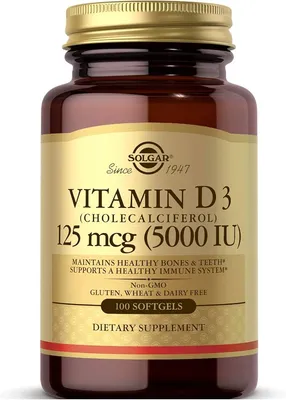
Solgar Vitamin D3 (Cholecalciferol) 5000 IU
Best high-dose vitamin D3 for adults over 50 with documented deficiency — Solgar's 75+ year reputation, oil-based softgel delivery, and clean formulation make this the brand pharmacists trust. Use with medical supervision and periodic blood testing.
- Gold-standard brand — Solgar has been manufacturing supplements since 1947
- Softgel form with oil base for superior absorption of fat-soluble D3
- Clean formula — no artificial colors, flavors, preservatives, or common allergens
- Therapeutic 5000 IU dose effectively restores deficient vitamin D levels
- 5000 IU is a therapeutic dose requiring blood level monitoring — not suitable for unsupervised daily maintenance
- Derived from lanolin (sheep wool oil) — not suitable for strict vegans
- Does not include vitamin K2, which many experts recommend pairing with high-dose D3
Solgar Vitamin D3 5000 IU is a therapeutic-dose cholecalciferol softgel from one of the most established supplement manufacturers in the world, designed for adults with documented vitamin D deficiency who need to restore adequate blood levels. At roughly $12 for 100 softgels, it offers gold-standard quality at an accessible price. One critical caveat: 5000 IU is not a casual maintenance dose — this level of supplementation should be guided by blood testing and medical supervision.
What Is Solgar Vitamin D3 5000 IU?
Solgar has been manufacturing supplements since 1947, making it one of the oldest supplement companies in the United States. Founded in New York, the company built its reputation on pharmaceutical-grade manufacturing standards long before the FDA established Good Manufacturing Practices (GMP) for the supplement industry. Solgar products are sold in over 60 countries and are a staple in pharmacies and health food stores alike.
Their Vitamin D3 5000 IU delivers cholecalciferol — the same form of vitamin D your skin produces from sunlight — in an oil-based softgel. The oil base matters. Vitamin D3 is fat-soluble, meaning it dissolves in fat, not water. Delivering it in a softgel with a safflower oil base ensures the vitamin is already dissolved and ready for absorption, bypassing a common barrier that dry tablet forms face.
This product exists because vitamin D deficiency in adults over 50 is not a minor issue — it’s an epidemic. And correcting a genuine deficiency requires a higher dose than the 600-1000 IU found in most multivitamins.
The Vitamin D Deficiency Epidemic in Adults Over 50
Vitamin D deficiency is one of the most widespread nutritional problems in the developed world, and adults over 50 are disproportionately affected. Multiple factors converge after 50 to create a perfect storm of declining vitamin D status.
Reduced skin synthesis: A 70-year-old’s skin produces approximately 75% less vitamin D from sunlight than a 20-year-old’s skin given the same UV exposure. This is the single biggest factor.
Less sun exposure: Older adults tend to spend more time indoors, and those in northern latitudes (above the 37th parallel — roughly San Francisco to Richmond, Virginia) cannot produce meaningful vitamin D from sunlight during the winter months regardless of time spent outdoors.
Dietary insufficiency: Very few foods contain significant vitamin D. Fatty fish (salmon, mackerel), egg yolks, and fortified milk provide some, but most adults don’t consume enough to meet their needs through diet alone.
Medication effects: Several medications common in the 50+ population — including corticosteroids, certain anticonvulsants, and cholestyramine — can interfere with vitamin D metabolism or absorption.
A landmark study published in Archives of Internal Medicine (2009) analyzed data from the National Health and Nutrition Examination Survey (NHANES) and found that 41.6% of American adults were vitamin D deficient (below 20 ng/mL), with rates climbing to 82.1% in Black adults and 69.2% in Hispanic adults. Among adults over 65, deficiency rates were even higher.
What’s Inside
Each softgel contains:
- Vitamin D3 (Cholecalciferol) — 5000 IU (125mcg): The preferred form of supplemental vitamin D. Cholecalciferol (D3) is the form your body naturally produces and is more effective at raising blood levels than ergocalciferol (D2). A meta-analysis in the American Journal of Clinical Nutrition (2012) confirmed that D3 raises 25(OH)D levels approximately 87% more effectively than D2.
- Safflower oil — serves as the fat-soluble carrier, enhancing absorption
- Softgel capsule (gelatin, vegetable glycerin) — easy to swallow, no tablet disintegration issues
That’s it. No fillers, no artificial colors, no preservatives. The simplicity of the formula is a strength — there’s nothing unnecessary in the capsule.
Free of gluten, wheat, dairy, soy, sugar, sodium, artificial flavor, and artificial color. Contains gelatin (from bovine sources) and safflower oil. Not vegan.
What the Research Says
The evidence for vitamin D supplementation in adults over 50 spans bone health, immune function, mood, and fall prevention — though the strength of evidence varies by outcome.
Bone health: This is where the evidence is strongest and least controversial. A 2005 meta-analysis in JAMA pooling data from over 60,000 participants found that vitamin D supplementation (at 700-800 IU daily or more) reduced hip fracture risk by 26% and non-vertebral fracture risk by 23% compared to placebo. The effect was dose-dependent — higher doses and higher achieved blood levels correlated with greater fracture reduction.
Fall prevention: A 2009 meta-analysis in the BMJ found that vitamin D supplementation reduced fall risk by 19% in older adults, with the benefit most pronounced at doses of 700-1000 IU daily. Falls are a leading cause of serious injury and loss of independence in older adults, making this a meaningful clinical outcome.
Immune function: A 2017 meta-analysis of 25 randomized controlled trials, published in the BMJ, found that vitamin D supplementation reduced the risk of acute respiratory tract infections by 12% overall, and by 42% in participants who were deficient at baseline. This finding gained particular attention during the COVID-19 pandemic, though the data on D3 and COVID specifically is still being clarified.
Mood and cognition: Observational studies consistently link low vitamin D levels with higher rates of depression and cognitive decline in older adults. A 2013 study in Neurology found that severe vitamin D deficiency was associated with a 125% increased risk of dementia. However, intervention trials have been less conclusive — supplementing vitamin D may not reverse existing cognitive decline, but maintaining adequate levels appears protective.
Who Is This Best For?
Solgar Vitamin D3 5000 IU is the right choice for adults over 50 who:
- Have blood-tested vitamin D levels below 30 ng/mL — this is the primary indication. Don’t guess — test first
- Live in northern latitudes with limited sun exposure, particularly during winter months
- Have darker skin — melanin reduces vitamin D production from sunlight by up to 90%
- Take medications that deplete vitamin D — corticosteroids, anticonvulsants (phenytoin, phenobarbital), cholestyramine, and orlistat
- Have conditions affecting fat absorption — Crohn’s disease, celiac disease, or history of gastric bypass surgery
- Spend most of their time indoors — homebound adults, nursing home residents, or those in institutional settings
You should choose a lower dose (1000-2000 IU) if your vitamin D levels are already in the normal range (30-50 ng/mL) and you’re looking for maintenance rather than correction. If you’re vegan, look for a D3 derived from lichen rather than lanolin — several brands now offer this.
How to Take It
Take one softgel daily with a meal that contains fat. Even a small amount of dietary fat — a handful of nuts, avocado on toast, a drizzle of olive oil — significantly improves vitamin D absorption.
Best timing: With your largest meal of the day, since this is when you’re most likely to consume adequate fat for absorption.
Blood monitoring schedule:
- Baseline: Get your 25(OH)D level tested before starting 5000 IU
- Recheck at 8-12 weeks: This is when levels typically plateau on a new dose. Your doctor will assess whether the dose is appropriate, too high, or insufficient
- Ongoing: Once stable, test every 6-12 months. If your levels reach 40-60 ng/mL, your doctor may reduce you to a maintenance dose of 1000-2000 IU daily
- Upper limit awareness: Blood levels consistently above 80-100 ng/mL carry risk of hypercalcemia (elevated blood calcium), which can cause nausea, kidney stones, and cardiac rhythm problems. This is why monitoring matters
Interactions to watch:
- Thiazide diuretics (hydrochlorothiazide) — these reduce calcium excretion. Combined with high-dose D3 (which increases calcium absorption), there’s a theoretical risk of hypercalcemia. Your doctor should monitor calcium levels
- Digoxin — hypercalcemia from excessive vitamin D can increase digoxin toxicity. If you take digoxin, your cardiologist should be aware of your D3 supplementation
- Cholestyramine and orlistat — these drugs reduce fat absorption, which can reduce D3 absorption. Take D3 at least 2 hours apart from these medications
Consider adding 100-200mcg of vitamin K2 (MK-7) to your regimen. The combination supports proper calcium distribution — into bones and teeth, rather than arteries and soft tissues.
The Bottom Line
Solgar Vitamin D3 5000 IU is the supplement your doctor reaches for when your blood work shows you’re running low on the “sunshine vitamin.” With 75+ years of manufacturing history, an oil-based softgel for optimal absorption, and a spotlessly clean formula, Solgar delivers the quality this critical nutrient deserves. Just remember: 5000 IU is a therapeutic tool, not a daily maintenance vitamin. Get tested, take the dose your levels require, and recheck periodically. Vitamin D supplementation is one of the simplest, most impactful interventions in senior health — when done right.
Always consult your doctor before starting any new supplement, especially if you take prescription medications. High-dose vitamin D3 requires periodic blood level monitoring.
Frequently Asked Questions
How do I know if I'm vitamin D deficient?
The only reliable way to know is a blood test called 25-hydroxyvitamin D (25(OH)D). Your doctor can order this as part of routine bloodwork. The Endocrine Society considers levels below 20 ng/mL deficient and levels between 20-29 ng/mL insufficient. Optimal levels for most adults are 30-50 ng/mL. Symptoms of deficiency can include fatigue, bone pain, muscle weakness, frequent illness, and mood changes — but many people with low vitamin D have no symptoms at all, which is why testing is essential. Adults over 50 are at higher risk because skin synthesis of vitamin D declines with age.
Is 5000 IU of vitamin D3 too much to take daily?
For someone with a documented deficiency (below 30 ng/mL), 5000 IU daily is a common and appropriate therapeutic dose that physicians regularly prescribe to restore adequate levels. However, this is not a one-size-fits-all dose. The Endocrine Society considers up to 4000 IU daily safe for most adults without monitoring, and notes that higher doses may be needed under supervision. Once your levels reach the 40-60 ng/mL range, your doctor will likely reduce you to a maintenance dose of 1000-2000 IU daily. Taking 5000 IU indefinitely without monitoring can lead to excessive levels over time, which carries risks of hypercalcemia.
Should I take vitamin D3 with vitamin K2?
Many healthcare professionals recommend pairing vitamin D3 with vitamin K2 (specifically MK-7), and the reasoning is sound. Vitamin D3 increases calcium absorption from your gut. Vitamin K2 directs that calcium into your bones and teeth rather than allowing it to deposit in your arteries and soft tissues. A 2017 study in the International Journal of Endocrinology found that the D3-K2 combination improved bone mineral density more effectively than either vitamin alone. If you're taking 5000 IU of D3, adding 100-200mcg of K2 (MK-7) is a reasonable precaution, particularly if you have cardiovascular risk factors.
Why does my doctor check vitamin D levels but my insurance sometimes doesn't cover the test?
Insurance coverage for vitamin D testing is inconsistent because guidelines differ on when screening is appropriate. The U.S. Preventive Services Task Force currently states there's insufficient evidence to recommend universal screening in asymptomatic adults, while the Endocrine Society recommends testing for at-risk populations — which includes most adults over 50. Many doctors order the test regardless because deficiency is so common in older adults and so easily correctable. If your insurance doesn't cover it, the out-of-pocket cost is typically $20-50 through direct-to-consumer lab services — a worthwhile investment given the importance of proper dosing.