
Best Multivitamins for Women Over 50 (Pharmacist Picks)
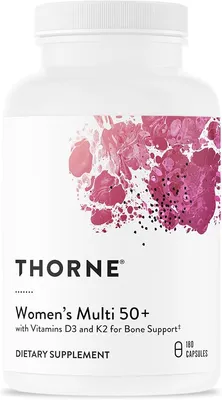
Thorne Women's Multi 50+
Best overall — clinical-grade quality, all the right forms, designed specifically for postmenopausal women. Pair with separate vitamin D3 if labs show low levels.
- Methylated B vitamins (methylcobalamin, L-methylfolate)
- Iron-free formulation appropriate for postmenopausal women
- 1,000 IU D3 + K2 (MK-7) and K1
The multivitamin aisle is full of products that look reasonable but use the wrong forms of nutrients, contain mega-doses of things you don’t need, and miss the things you do.
For women over 50, the right multivitamin is foundational — fills nutritional gaps that diet alone often misses, and provides the platform for any specific targeted supplements you add on top.
This guide covers what to look for, what to skip, and the specific picks that match the criteria.
Key Takeaways
- Look for methylated B12 (methylcobalamin) and L-methylfolate — older adults absorb these better.
- Vitamin D3 1,000-2,000 IU paired with vitamin K2 (MK-7) — pair, don’t separate.
- Magnesium glycinate or citrate, NEVER oxide.
- Iron-free formulation for most postmenopausal women.
- Skip: One A Day, Centrum Silver, gummies, megadose products.
- Best overall: Thorne Women’s Multi 50+ — clinical-grade quality, all the right forms.
- Multivitamins are foundational, not therapeutic — pair with targeted individual supplements (omega-3, vitamin D at higher doses, B12 if low) for actual health effects.
What changes after 50
Multiple physiological shifts make supplement needs different in women over 50:
1. Reduced stomach acid.
Atrophic gastritis affects 20-30% of adults over 50, reducing stomach acid production. This impairs absorption of:
- B12 (requires acidic environment for cleavage from food protein).
- Iron (acid converts ferric to absorbable ferrous form).
- Calcium (carbonate forms require acid).
- Some forms of magnesium.
The fix: methylated B12 (bypasses the stomach acid step), iron only when needed (and from citrate forms), calcium citrate (acid-independent), magnesium glycinate or citrate.
2. Postmenopausal iron status.
No more menstrual blood loss = iron tends to accumulate. The premenopausal iron RDA of 18mg drops to 8mg postmenopause — usually met from diet alone.
The fix: iron-free multi for most women. Add iron only with documented deficiency.
3. Bone density acceleration.
Estrogen loss accelerates bone resorption. Calcium, vitamin D3, vitamin K2, and magnesium all support bone health.
The fix: D3 + K2 paired (not just D3); calcium 600-800mg total daily (food + supplement); magnesium 300-400mg daily.
4. MTHFR variants and folate metabolism.
About 30-50% of the population has MTHFR variants reducing the conversion of folic acid to active folate. Methylated forms bypass this issue.
The fix: L-methylfolate (5-MTHF) or folinic acid, not folic acid.
5. Reduced kidney function with age.
Modest decline in kidney function affects vitamin D activation and some mineral handling.
The fix: vitamin D3 (which kidneys can still convert) rather than D2; conservative dosing of fat-soluble vitamins; avoid mega-doses.
What to look for
B vitamins
B12: methylcobalamin (or hydroxocobalamin), NOT cyanocobalamin.
Cyanocobalamin requires conversion to active forms in the liver. Older adults with reduced absorption struggle with this. Methylcobalamin is the active form — directly absorbed and used.
A 2013 NEJM review by Stabler noted that methylcobalamin is preferred for adults over 50, particularly those with absorption issues or MTHFR variants.
Dose: 250-1,000 mcg daily in a multi is reasonable. Higher doses (2,500-5,000 mcg) may be needed if you have low B12 levels or pernicious anemia.
Folate: L-methylfolate (5-MTHF) or folinic acid, NOT folic acid.
The MTHFR enzyme converts folic acid to active folate. Variants reduce this conversion in 30-50% of the population. L-methylfolate skips this step.
Dose: 400-800 mcg DFE (dietary folate equivalents) daily.
B6: pyridoxal-5-phosphate (P5P) is the active form, but pyridoxine HCl is acceptable for most.
Vitamin D + K
Vitamin D3 (cholecalciferol), NOT D2 (ergocalciferol). D3 raises blood levels more efficiently.
Dose: 1,000-2,000 IU in a multi. Many women over 50 need 4,000-5,000 IU total daily for optimal blood levels (30-50 ng/mL) — pair multi with separate D3 supplement based on labs.
Vitamin K2 as MK-7, ideally 90-180 mcg daily.
K2 directs calcium to bones rather than arteries. Pair with D3 — the combination is more effective than either alone for bone and cardiovascular health.
Many multivitamins include only K1 (phylloquinone), which doesn’t have the same arterial-calcification protection effects. Look specifically for K2 (MK-7).
Minerals
Magnesium: glycinate or citrate, NOT oxide.
Magnesium oxide has only 4% absorption. Glycinate and citrate have 30-50% absorption. The absorption difference is large and clinically meaningful.
Multivitamin doses of magnesium are typically 100-200mg — usually insufficient for full magnesium needs. Most women over 50 benefit from a separate evening magnesium supplement (300-400mg glycinate). See Best Magnesium Supplements for the standalone pick.
Calcium: citrate is preferred over carbonate, especially for women on acid reducers.
Multivitamin calcium is usually 200-400mg. Total daily target is 1,000-1,200mg from food + supplement combined. Most women get 600-800mg from diet — multivitamin makes up the difference.
Iron: skip for most postmenopausal women. If labs show deficiency (ferritin <30 ng/mL), supplement separately with iron bisglycinate or ferrous sulfate.
Zinc: 8-15mg is reasonable. Higher doses can interfere with copper absorption.
Selenium: selenomethionine is preferred over sodium selenite. 55-100 mcg daily.
Iodine: 75-150 mcg for women without thyroid issues. Skip in multivitamin if you have Hashimoto’s or hyperthyroidism.
What to skip
Mega-dose vitamin A. Beta-carotene >3,000 mcg RAE or vitamin A retinol >3,000 mcg can be problematic, especially for smokers (lung cancer risk in CARET trial).
Mega-dose vitamin E. >400 IU has been associated with increased mortality in some meta-analyses.
Mega-dose B6. >100mg daily can cause peripheral neuropathy (nerve damage in extremities). Most multis stay below 50mg.
Iron in multivitamins for postmenopausal women without documented deficiency.
Cyanocobalamin, folic acid, magnesium oxide — substandard forms.
The pharmacist picks
1. Thorne Women’s Multi 50+ — Best Overall
Thorne is the gold standard for clinical-grade supplements. NSF Certified for Sport (third-party tested for purity), used by Mayo Clinic and major hospital systems.
The product: 6 capsules daily delivers comprehensive nutrient coverage with all the right forms — methylcobalamin, L-methylfolate, magnesium citrate, vitamin D3 + K2, iron-free.
Cost: ~$50/month.
Trade-off: Premium price. 6 capsules daily is a larger pill burden than 1-2 tablet alternatives. The 1,000 IU D3 may be insufficient — most women need additional D3.
Pick this if: You want clinical-grade quality and don’t mind the cost or pill burden.
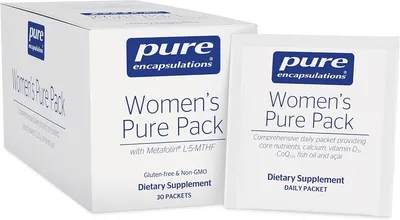
2. Pure Encapsulations Women’s Pure Pack — Best Comprehensive Coverage
Pure Encapsulations is another clinical-grade brand favored by integrative medicine practitioners. The “Women’s Pure Pack” is a daily packet system combining multivitamin + omega-3 + CoQ10 + bone support.
The product: Daily packets with all the forms in the Thorne pick plus targeted individual supplements.
Cost: ~$65/month.
Trade-off: Most expensive option. Daily packets require management. One-size-fits-all approach (no customization).
Pick this if: You want comprehensive coverage in one pack and don’t want to manage individual supplements separately. The convenience factor is real.
3. Garden of Life mykind Organics Women’s Multi 50+ — Best Whole-Food
Garden of Life’s mykind Organics line is the strongest whole-food option — USDA Organic certified, vegan, made from sprouted grains and vegetables.
The product: 2 tablets daily, methylated B12, vegan vitamin D3, iron-free.
Cost: ~$38/month.
Trade-off: Lower per-tablet doses (whole-food matrix has space limits). Whole-food absorption advantage over synthetic is modest. More expensive than synthetic equivalents.
Pick this if: You prefer plant-based, organic supplements and value the whole-food philosophy. Quality is real even if the absorption advantage is modest.
4. Ritual Essential for Women 50+ — Best Minimal Formulation
Ritual takes a different approach: focus on the 9 most-likely-deficient nutrients in modern diets and skip the rest. Methylated B12, L-methylfolate, vegan, transparent sourcing.
The product: 2 capsules daily delivering 9 key nutrients in optimal forms. Delayed-release capsules for absorption.
Cost: ~$38/month (subscription).
Trade-off: Skips some vitamins entirely (no vitamin C, no biotin, no choline). Subscription-only model. Conservative dosing — may need to supplement individually.
Pick this if: You want a focused, transparent multi rather than a comprehensive one. Best paired with separate vitamin C, omega-3, and other targeted supplements.
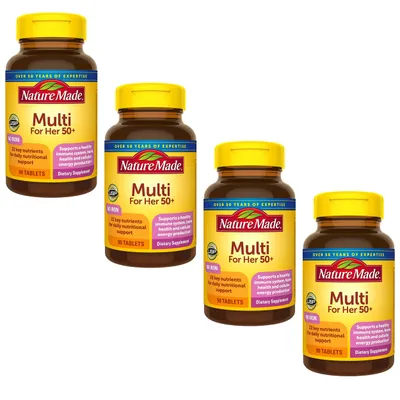
5. Nature Made Multi for Her 50+ — Best Budget
Lowest price option with adequate quality. USP Verified (third-party tested for content and purity).
The product: 1 tablet daily. Iron-free. Reasonable doses of D3, B12, calcium.
Cost: ~$18/month.
Trade-off: Cyanocobalamin (not methylcobalamin) for B12. Folic acid (not L-methylfolate) for folate. Magnesium oxide (poor absorption). Forms aren’t ideal but cost is right.
Pick this if: You’re on a tight budget and want something USP-verified. Reasonable starter multi; upgrade to higher-quality forms when budget allows.
Common mistakes
Mistake 1: Taking a multivitamin and assuming you’re covered.
Multivitamins are foundational but rarely sufficient alone. Most women over 50 also need:
- Vitamin D3 4,000-5,000 IU (multi has 1,000-2,000)
- Magnesium glycinate 300-400mg evening (multi has 100-200)
- Omega-3 EPA+DHA 1,000-2,000mg (multi has none or trace)
- Possibly B12 if levels are low
The multi is the platform; targeted supplements provide therapeutic effect.
Mistake 2: Picking by marketing rather than nutrient forms.
“50+ Women’s Formula” with cyanocobalamin and folic acid is worse than a generic multi with methylcobalamin and L-methylfolate. The forms matter more than the marketing demographic.
Mistake 3: Not getting baseline labs.
Without knowing your starting B12, vitamin D, and iron status, you’re guessing about what to supplement. Annual labs (B12, 25-hydroxyvitamin D, ferritin, magnesium) inform supplement choices and reveal gaps.
Mistake 4: Taking gummies for the convenience.
Gummy multivitamins typically have 30-50% of the doses found in tablet alternatives, plus 2-4g sugar daily. Tablets and capsules are slightly less convenient but meaningfully more effective.
Mistake 5: Stopping iron-containing multis you took for years.
Many women over 50 are still on premenopausal multivitamins with iron. Switch to iron-free formulations once you’re past menopause and confirmed not iron-deficient. Continued iron supplementation without need can accumulate.
Mistake 6: Adding individual mega-doses on top of a multi.
Taking your multi (which has 100% RDA of vitamin A) plus a separate vitamin A supplement plus a green powder plus a “women’s hormone formula” can produce mega-doses unintentionally. Add up your total intake from all sources.
What to add on top
A multivitamin is foundation. Most women over 50 benefit from these targeted supplements layered on top:
Vitamin D3 4,000-5,000 IU daily (with the multi’s K2 making the pair). Gets blood levels to 30-50 ng/mL target range.
Omega-3 EPA+DHA 1,000-2,000mg daily (Nordic Naturals Ultimate Omega is the standout pick). Supports brain, heart, joint health.
Magnesium glycinate 300-400mg evening. Sleep, anxiety, blood pressure, glucose handling — all benefit.
B12 sublingual if levels are low (<400 pg/mL). Methylcobalamin 1,000-2,500 mcg daily.
Probiotic (50+ formulations) for gut and immune health.
For specific symptom needs, see the relevant guides:
- Best Bone Health Supplements
- Best Menopause Supplements
- Best Probiotics for Women Over 50
- Best Supplements for Energy After 60
Who shouldn’t take a multivitamin
Most women over 50 can safely take a multivitamin, but a few exceptions:
Hemochromatosis or iron overload conditions. Even iron-free multis sometimes have small amounts; verify and consider single-nutrient supplementation instead.
Active kidney stones. High-dose calcium and oxalate-rich vitamin C can contribute. Discuss with nephrologist.
Hyperthyroidism. Some multivitamins contain iodine, which can worsen hyperthyroid states. Pick iodine-free or single-nutrient approach.
On warfarin. Multivitamins with vitamin K can interact. Either pick a vitamin-K-free multi or maintain consistent intake (don’t add or remove K-containing products) and inform your anticoagulation clinic.
Hypervitaminosis A history. Skip multivitamins with retinol forms of vitamin A; use beta-carotene-only or no vitamin A.
The bottom line
The right multivitamin for women over 50 has methylated B vitamins, vitamin D3 + K2, magnesium glycinate or citrate, no iron, and reasonable doses across the spectrum. It’s foundational — fills gaps and provides platform for targeted individual supplements.
Best overall: Thorne Women’s Multi 50+. Best comprehensive: Pure Encapsulations Women’s Pure Pack. Best budget: Nature Made Multi for Her 50+.
Skip: One A Day, Centrum Silver, gummy multivitamins, megadose products.
Pair the multi with separate vitamin D3 (most need 4,000-5,000 IU total), magnesium glycinate evening, and omega-3 — these have larger therapeutic effect than the multi alone.
Get annual labs (B12, vitamin D, ferritin, magnesium) to inform supplement choices and reveal gaps the multi doesn’t cover.
Sources
- Stabler, 2013 — Vitamin B12 deficiency in older adults (NEJM)
- Institute of Medicine, 2010 — Dietary Reference Intakes for Calcium and Vitamin D
- Holick, 2007 — Vitamin D deficiency (NEJM)
- Schwalfenberg, 2017 — Vitamins K1 and K2: the emerging group of vitamins
- Allen, 2009 — Causes of vitamin B12 and folate deficiency
- Ross et al., 2011 — IOM dietary reference intakes vitamin D
All Products We Reviewed
- Methylated B vitamins (methylcobalamin, L-methylfolate)
- Iron-free formulation appropriate for postmenopausal women
- 1,000 IU D3 + K2 (MK-7) and K1
- NSF Certified for Sport — third-party tested for purity
- Magnesium citrate, not oxide
- Premium price ($50+/month)
- 6 capsules daily — larger pill burden than 1-2 tablet alternatives
- 1,000 IU D3 may be insufficient — most women need additional D3
- Daily-pack format with multivitamin + omega-3 + CoQ10 + bone support
- Methylated B vitamins, USP-grade ingredients
- Comprehensive coverage — multi + key individual supplements in one pack
- Hypoallergenic, free of common excipients
- Most expensive option ($65+/month)
- Daily packets require management; some find it cumbersome
- Not customizable — one-size-fits-all approach
- Whole-food, USDA Organic certified
- Methylated B12, vitamin D3 (vegan source)
- Iron-free formulation
- Vegan, gluten-free, kosher
- Lower per-tablet doses — requires 2 tablets daily
- Whole-food advantage is marketing-heavy and modest in clinical effect
- More expensive than synthetic equivalents
- Methylated B12, L-methylfolate
- Vegan, transparent sourcing
- Delayed-release capsules for better absorption
- Iron-free, focused on nine key nutrients
- Selective ingredient list — skips some vitamins (no vitamin C, no biotin)
- Subscription-only purchasing model
- Doses are conservative — may need to supplement individually
- USP Verified — third-party tested for content and purity
- Inexpensive — about $0.30-0.40 per day
- Iron-free formulation
- Reasonable doses of D3, B12, calcium
- Cyanocobalamin (not methylcobalamin) for B12
- Folic acid (not L-methylfolate) for folate
- Magnesium oxide (poor absorption)
Frequently Asked Questions
Do women over 50 actually need a multivitamin?
Most can benefit modestly, some don't need one. The case for: most women over 50 don't consistently meet RDAs for vitamin D, magnesium, B12, and omega-3 from diet alone. Multi provides nutritional insurance for gaps. The case against: a multivitamin doesn't substitute for a quality diet, doesn't treat specific deficiencies, and at low doses provides minimal benefit beyond food. The reasonable middle ground: take a quality multivitamin as foundation, plus targeted individual supplements for specific gaps identified through labs (vitamin D if low, B12 if low, magnesium if you have signs of deficiency). Women who eat varied diets including fish, leafy greens, dairy, and eggs may need only a vitamin D supplement. Women with restrictive diets, GI absorption issues, or documented deficiencies benefit more from a comprehensive multi. Don't expect dramatic effects from a multivitamin alone — it's foundational, not therapeutic.
What forms of nutrients should I look for in a multivitamin?
Specific forms matter for absorption and efficacy in women over 50. (1) B12 — methylcobalamin or hydroxocobalamin, NOT cyanocobalamin. Cyanocobalamin requires conversion to active forms; older adults with reduced stomach acid absorb methylcobalamin 50-70% better. (2) Folate — L-methylfolate (5-MTHF) or folinic acid, NOT folic acid. About 30-50% of the population has MTHFR variants reducing folic acid conversion. (3) Vitamin D — D3 (cholecalciferol), NOT D2 (ergocalciferol). D3 raises blood levels more efficiently. (4) Vitamin K — K2 as MK-7, NOT just K1. K2 directs calcium to bones rather than arteries. (5) Magnesium — glycinate or citrate, NOT oxide. Oxide has 4% absorption vs 30-50% for glycinate. (6) Iron — iron-free for most postmenopausal women. Excess iron can accumulate without menstrual losses. (7) Selenium — selenomethionine, NOT sodium selenite. (8) Calcium — citrate is more absorbable than carbonate, especially for women on acid reducers.
Are gummy multivitamins okay for women over 50?
No — three reasons. (1) Sub-clinical doses. Gummies have limited 'space' for active ingredients due to sugar and gelatin matrix; most have 30-50% of the doses found in tablet/capsule alternatives. You'd need to take 3-5 gummies to match a single tablet's content, and most don't recommend that. (2) Sugar load. Most gummies have 2-4g of sugar per serving (2 gummies). Doesn't sound like much, but daily over years adds up — and counters insulin sensitivity work that's important during menopause. (3) Stability and form issues. Vitamin C and B vitamins degrade faster in gummy formats; some gummies have less of these vitamins by the end of shelf life than the label states. Specific brand exception: Garden of Life and Ritual offer some quality gummy formats with reasonable doses, but tablets and capsules outperform gummies on average. The 'easier to take' argument doesn't hold up — modern multivitamin tablets are smaller and more swallowable than ever.
Why iron-free for postmenopausal women?
Postmenopausal women lose the monthly iron drain of menstruation. Without that loss, iron stores tend to accumulate, and excess iron is associated with cardiovascular and cognitive concerns. The 2010 IOM dietary reference intake panel reduced the iron RDA for postmenopausal women from 18mg (premenopausal) to 8mg — most women easily meet this from diet alone (red meat, fortified cereals, leafy greens). Multivitamins designed for women over 50 should be iron-free or contain minimal iron (<5mg). Exceptions: women with diagnosed iron deficiency anemia (low ferritin, low hemoglobin) need supplemental iron, but typically as a separate iron-only supplement with vitamin C for absorption. Women on chemotherapy or with chronic GI bleeding may need iron. Most postmenopausal women: skip iron in the multi. Get ferritin and hemoglobin checked yearly to confirm levels are adequate.
Should I take vitamin D and K2 separately or in the multivitamin?
A good multivitamin includes both, but the dose may not be enough — most multivitamins contain 1,000 IU vitamin D, which is below the dose many women need to maintain blood levels in the 30-50 ng/mL range (current target). Practical approach: (1) Start with a multivitamin containing 1,000-2,000 IU D3 + 90-180 mcg K2 (MK-7). (2) Get vitamin D blood level (25-hydroxyvitamin D) tested. (3) If level is below 30 ng/mL, add a separate D3 + K2 supplement to reach total of 2,000-5,000 IU D3 daily. Many women over 50 need 4,000-5,000 IU daily to maintain optimal levels, especially in northern latitudes or with limited sun exposure. K2 (MK-7) at 90-180mcg daily directs calcium to bones rather than arteries — important for bone health and cardiovascular risk. The pair (D3 + K2) is more effective than either alone. See our guide on [Vitamin D for Women Over 50](/supplements/immune-health/best-vitamin-d-supplements/) for the deep dive.
What about food-based vs synthetic multivitamins?
The 'food-based' marketing is mostly marketing. Whole-food multivitamins (Garden of Life, MegaFood) use synthetic vitamins cultured with food matrices — the vitamins themselves are typically the same molecules as in synthetic multivitamins. The food matrix may marginally improve absorption for some nutrients, particularly fat-soluble vitamins (A, D, E, K), but the effect is usually modest. The trade-offs: (1) Food-based multis often have lower per-tablet doses, requiring 2-4 tablets daily. (2) They're more expensive — typically 2-3x the cost. (3) They may contain trace amounts of allergens (yeast, sprouted grains) — relevant for sensitive individuals. (4) The absorption advantage is real for some nutrients but small. Practical view: synthetic multivitamins from quality brands (Thorne, Pure Encapsulations) are clinically equivalent for most women. Choose food-based if you prefer the philosophy and tolerate the cost; choose synthetic if you want clinical-grade dosing at lower cost.
How long should I take a multivitamin?
Indefinitely is fine for most women, but reassess yearly. Multivitamins are designed for daily use across decades — the doses are below toxicity thresholds and the cumulative effects of mild nutritional support are favorable. What to monitor: (1) Annual labs including B12, vitamin D (25-hydroxyvitamin D), ferritin, magnesium (RBC magnesium if available), and TSH. (2) Adjust supplement choice based on labs — if vitamin D is low, add separate D3. If B12 is high (above 900 pg/mL), reduce or stop B12-heavy multis. If iron status is high (ferritin >150 ng/mL), confirm multi is iron-free. (3) Update for life events — pregnancy planning, surgery, chemotherapy, new diagnoses may change supplement needs. (4) Reassess if symptoms change — fatigue, hair loss, new neurological symptoms warrant lab work and possible supplement adjustment. Don't take the same multi for 20 years without ever rechecking; needs change.