
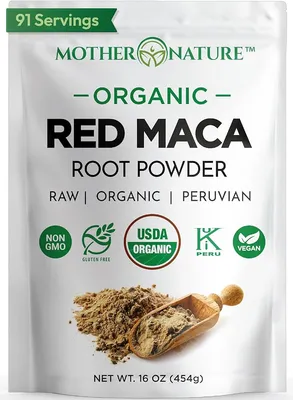
The Maca Team Red Maca for Women
The best maca supplement for women's health — organically grown, fair-trade, and backed by growing evidence for libido support and hormone balance during menopause.
- Organic, fair-trade sourced from Junin, Peru at 14,000+ feet
- Red maca variety specifically studied for women's health
- Available in both raw and gelatinized forms
- Promising research for libido and menopausal symptom support
- Evidence base is smaller than black cohosh or soy isoflavones
- Earthy taste may be off-putting in powder form
- Higher price point for a food-based supplement
The Maca Team Red Maca for Women is an organic, fair-trade maca supplement sourced directly from the highlands of Junin, Peru, where maca has been cultivated for thousands of years. Red maca — the specific color variety with the most research relevant to women’s health — has shown promising results for hormone balance, libido support, and overall menopausal well-being. While the evidence base is more modest than for heavily studied options like black cohosh, the research is real, the traditional use runs deep, and many women over 50 find that red maca fills a gap that other supplements don’t address, particularly when it comes to sexual desire and vitality.
What Is The Maca Team Red Maca?
The Maca Team is a small, specialized company that works directly with Peruvian farming cooperatives in the Junin region — the only place in the world where maca grows at its traditional altitude of 14,000 feet and above. This matters because maca grown at lower altitudes or in other countries (as some cheap products use) has a different chemical profile than traditionally cultivated Peruvian maca.
Maca (Lepidium meyenii) is a cruciferous root vegetable related to broccoli and turnips. It has been used in Peruvian traditional medicine for centuries as a fertility and vitality tonic. Among the three color varieties — red, black, and yellow — red maca has drawn the most attention for women’s health. It contains a unique profile of glucosinolates, macamides, and macaenes — bioactive compounds that researchers believe are responsible for its hormone-balancing effects.
What’s Inside
The Maca Team offers red maca in both capsule and powder forms, in raw and gelatinized versions. Each serving (typically 3 capsules or 1 teaspoon of powder) delivers approximately 3,000mg of organic red maca.
In capsule form, the only other ingredient is the vegetable cellulose capsule shell. The powder form is pure maca with nothing added. The product is USDA Organic certified, vegan, gluten-free, non-GMO, and fair-trade. No fillers, binders, flow agents, or preservatives are used.
The gelatinized version has undergone a traditional heating process that removes the starch content, concentrating the active compounds and making the maca significantly easier to digest. This is not gelatin-based — “gelatinized” refers to the starch removal process, and the product remains fully vegan.
What the Research Says
A 2008 randomized, double-blind, placebo-controlled study published in Menopause followed early postmenopausal women taking maca for 6 weeks. Women in the maca group experienced significant reductions in anxiety, depression, and sexual dysfunction scores compared to placebo. The researchers noted improvements across multiple domains without any changes in serum estrogen levels — suggesting maca works through mechanisms other than directly raising hormones.
A systematic review and meta-analysis in BMC Complementary and Alternative Medicine evaluated four randomized clinical trials and concluded that maca may improve sexual desire. The authors noted that the evidence was limited but consistent, and called for larger confirmatory trials.
Red maca specifically has been studied for bone health. Research published in Reproductive Biology and Endocrinology found that red maca had the strongest bone-protective effects among the three color varieties in ovariectomized animal models — a standard model for postmenopausal bone loss. While animal studies don’t directly translate to humans, the findings support the traditional selection of red maca for women’s health.
A 2005 study in the International Journal of Biomedical Science found that maca improved quality of life scores and reduced body mass index in postmenopausal women over 2 months, with no adverse effects on liver enzymes, blood glucose, or blood pressure.
Who Is This Best For?
The Maca Team Red Maca is a particularly good fit if you:
- Want to support libido naturally — this is where maca has the most unique promise, filling a gap that other menopause supplements don’t address well
- Prefer a whole-food supplement — maca is a food, not an isolated compound, which appeals to women who prefer less processed options
- Care about sourcing and ethics — fair-trade, organic, direct-from-Peru sourcing sets this apart from cheap maca products
- Want adaptogenic support — maca is classified as an adaptogen, potentially helping your body manage stress and hormonal shifts more effectively
- Experience menopause-related mood changes — the clinical data shows meaningful improvements in anxiety and depression scores
If your primary concern is hot flashes and night sweats, black cohosh (Remifemin) or soy isoflavones have stronger evidence for those specific symptoms. Red maca’s strengths lie more in libido, mood, and overall vitality.
How to Take It
Capsules: Take 3 capsules daily with food. Start with 2 capsules for the first week to assess tolerance, then increase to the full dose.
Powder: Mix 1 teaspoon (approximately 3g) into a smoothie, coffee, oatmeal, or juice. Maca powder has an earthy, malty flavor that pairs well with chocolate, banana, and nut butters. Start with half a teaspoon and work up.
Timing tip: Many women prefer taking maca in the morning or early afternoon, as some find it mildly energizing. Avoid taking it close to bedtime if you notice any stimulating effect.
Interactions to watch: Maca is a cruciferous vegetable and contains goitrogens, which can theoretically affect thyroid function in susceptible individuals. If you have a thyroid condition or take thyroid medication, discuss maca with your doctor before starting.
Always consult your doctor before starting maca supplementation, especially if you take medications for thyroid conditions, blood pressure, or hormone-sensitive conditions.
The Bottom Line
The Maca Team Red Maca for Women fills a unique niche in the menopause supplement landscape. While it may not have the extensive trial data of black cohosh or soy isoflavones, it offers something those supplements don’t — genuine promise for libido support and overall vitality during menopause. The organic, fair-trade sourcing directly from Peru ensures you’re getting authentic, traditionally grown maca rather than the low-altitude knockoffs flooding the market. For women over 50 who want to address the energy and desire side of menopause, red maca is worth exploring alongside more targeted symptom-specific supplements.
Frequently Asked Questions
Does red maca really help with libido after menopause?
The evidence is promising but still early. A 2008 study published in Menopause found that maca significantly reduced psychological symptoms including anxiety and depression, and improved sexual dysfunction scores in postmenopausal women compared to placebo. A separate systematic review in BMC Complementary and Alternative Medicine concluded that maca may improve sexual desire, though the authors called for larger trials. Many women report noticeable improvements in interest and arousal after 6 to 8 weeks of consistent use.
What is the difference between red, black, and yellow maca?
Maca grows in three color varieties — red, black, and yellow — each with a slightly different nutrient and compound profile. Red maca has been specifically studied in women for hormone balance and showed the strongest bone-protective effects in animal studies. Black maca is more commonly studied for male fertility and memory. Yellow maca is the most common and least studied. For women's health concerns, red maca is the variety with the most relevant research.
Should I choose raw or gelatinized red maca?
Gelatinized maca has had the starch removed through a heating process, making it easier to digest and concentrate the active compounds. If you have a sensitive stomach or digestive issues, gelatinized is the better choice. Raw maca retains all original compounds including the starch and enzymes, which some prefer for a less processed product. Both forms are effective. The Maca Team offers both options so you can choose based on your digestive comfort.
How long does red maca take to work for menopausal symptoms?
Most clinical studies evaluated maca over 6 to 12 weeks, and many women report noticing changes in energy and mood within the first 2 to 4 weeks. Libido improvements typically take longer — 6 to 8 weeks is a reasonable expectation. Maca is considered an adaptogen, meaning its effects build gradually as it helps your body adapt to hormonal changes. Consistency is important — take it daily rather than sporadically.