
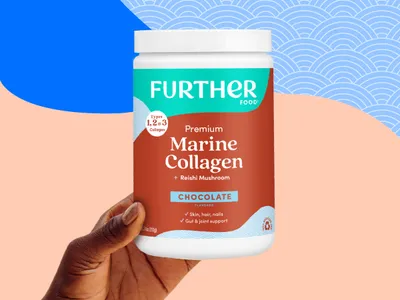
Further Food Marine Collagen Peptides
Best marine collagen for adults over 50 — wild-caught sourcing, type I collagen for skin, and smaller peptides for absorption. The top pescatarian-friendly option.
- Wild-caught deep-sea fish source — no farmed fish, no antibiotics
- Type I collagen — the primary collagen in human skin
- Smaller peptide fragments for potentially better absorption
- Unflavored powder dissolves cleanly without fishy taste
- Fish allergen — not suitable for those with fish/shellfish allergies
- Only type I collagen (no type III for broader connective tissue support)
- Slightly more expensive than bovine collagen per serving
Further Food Marine Collagen Peptides is our top marine collagen pick for adults over 50. Sourced from wild-caught deep-sea fish, it provides type I collagen — the dominant collagen in human skin — in smaller peptide fragments engineered for efficient absorption. For women over 50 who prefer a pescatarian-friendly alternative to bovine collagen, or who simply want the collagen type most directly tied to skin health, Further Food offers a clean, transparent product that dissolves without a trace of fishiness.
What Is Further Food Marine Collagen?
Further Food is a New York-based wellness company founded with a focus on real food and clean supplementation. Their Marine Collagen Peptides are sourced exclusively from wild-caught deep-sea cod from the North Atlantic — no farmed fish, no antibiotics, no artificial feed. The company uses only fish skin (not scales or bones), which produces a higher-purity collagen with a cleaner taste profile.
What sets marine collagen apart from the more common bovine collagen is its type I specificity. While bovine collagen provides both type I and type III, marine collagen is predominantly type I — the same collagen that makes up roughly 80% of your skin’s collagen structure. Type I is also the collagen most responsible for skin elasticity, hydration, and that “plump” quality that naturally diminishes after 50. If skin is your primary concern, marine collagen is the most targeted source.
Further Food’s peptides undergo enzymatic hydrolysis — a process that breaks the collagen into very small peptide fragments (typically under 5,000 Daltons in molecular weight). These smaller peptides are theoretically absorbed more efficiently in the gut and reach the skin more readily through the bloodstream. Marine collagen peptides tend to be naturally smaller than bovine peptides due to the fish collagen’s molecular structure.
What’s Inside
Each one-scoop serving provides:
- 7g marine collagen peptides — from wild-caught North Atlantic cod skin (type I collagen)
- Amino acid profile rich in glycine (approximately 22%), proline (approximately 12%), and hydroxyproline (approximately 10%) — the three amino acids most critical for collagen synthesis
That’s it. No added vitamins, minerals, sweeteners, flavors, or fillers. The ingredient list is literally one item: hydrolyzed fish collagen peptides. This purity is a double-edged sword — you get maximum collagen per serving with nothing you don’t want, but you also don’t get the added biotin or silica found in some competitors’ beauty formulas.
The powder is certified non-GMO, gluten-free, dairy-free, and sugar-free. It does contain fish, so it’s not suitable for people with fish allergies.
What the Research Says
Marine collagen research has expanded significantly in recent years, with studies specifically examining its effects on aging skin.
A 2018 randomized controlled trial gave women aged 40-60 fish collagen peptides daily for 8 weeks. The supplemented group showed statistically significant improvements in skin moisture content and skin elasticity compared to placebo. Wrinkle depth also decreased, though the difference reached significance only after 12 weeks. These results mirror the broader collagen meta-analyses but with a marine-specific source.
A 2016 study in the Journal of the Science of Food and Agriculture found that marine collagen peptides were absorbed intact in the gut and detected as collagen-specific peptides (particularly prolyl-hydroxyproline, or Pro-Hyp) in the bloodstream. These dipeptides are believed to signal fibroblasts in the skin to produce new collagen — meaning supplemental collagen doesn’t just provide raw materials, it may actively stimulate your body’s own collagen production.
The broader 2019 meta-analysis of 11 RCTs (805 total participants) found that hydrolyzed collagen supplementation — including both marine and bovine sources — significantly improved skin hydration, elasticity, and wrinkle reduction. The analysis noted that benefits were consistent across both collagen sources, though marine collagen studies tended to use lower doses (5-10g) compared to bovine studies (10-15g).
For absorption specifically, a 2015 study comparing marine and bovine collagen peptides found that marine-derived peptides achieved higher blood concentrations of the key bioactive dipeptide Pro-Hyp — suggesting that the smaller molecular weight of marine collagen may indeed translate to better bioavailability.
Who Is This Best For?
Further Food Marine Collagen is a strong match for:
- Women over 50 focused primarily on skin health — type I marine collagen is the most targeted source for the collagen type that dominates your skin
- Pescatarians and those who avoid beef products — this is the highest-quality non-bovine collagen option we’ve reviewed
- People who want the simplest possible ingredient list — one ingredient, nothing else
- Anyone who has been put off by fishy-tasting marine collagen products — Further Food’s processing produces a genuinely neutral-tasting powder
- Those interested in potentially better absorption — the smaller peptide size of marine collagen may offer a bioavailability advantage
This may not be the best fit if you have a fish allergy (bovine collagen is your safer option), if you want a more comprehensive beauty formula with added biotin and silica (Garden of Life Collagen Beauty offers that), or if you need type III collagen for broader connective tissue support such as joint health (bovine collagen covers both types I and III).
How to Take It
Mix one scoop (7g) into 8 ounces of any beverage — hot or cold. Coffee and tea are the most popular choices, and the powder dissolves well in both without affecting flavor. It also works in smoothies, soups, or overnight oats. For cold beverages, stir vigorously or use a small whisk — it may clump slightly if you dump it in all at once. Adding the powder gradually while stirring prevents this.
Timing tip: Like all collagen supplements, consistency matters more than timing. Pick a time that fits your routine — morning coffee is a common habit anchor — and take it daily. Some research suggests taking collagen on an empty stomach may improve peptide absorption, but the difference is likely small compared to the benefit of simply being consistent.
Boosting absorption: Vitamin C is a required cofactor for your body to synthesize new collagen from the peptides you consume. Pairing your marine collagen with a source of vitamin C — a glass of orange juice, berries in your smoothie, or a simple vitamin C supplement — may enhance the collagen-building effect.
Dose considerations: The standard serving is 7g. Some people double it to 14g (two scoops) for the first 8-12 weeks to build up levels faster, then drop to one scoop for maintenance. The clinical evidence supports both approaches, though higher doses haven’t been definitively shown to produce faster results.
Interactions to watch: Collagen peptides have very few known drug interactions. If you take medications for calcium metabolism or kidney function, mention collagen supplementation to your doctor — collagen’s hydroxyproline content is metabolized through pathways that involve calcium.
As with any supplement, consult your doctor before starting marine collagen, particularly if you have fish allergies, kidney concerns, or are taking medications that affect protein metabolism.
The Bottom Line
Further Food Marine Collagen Peptides earns a 4.4 rating for delivering the cleanest, most transparent marine collagen we’ve reviewed. Wild-caught sourcing, a single-ingredient formula, genuinely neutral taste, and the type I collagen most directly relevant to skin health — it does everything right for adults over 50 who want a pescatarian-friendly collagen with strong absorption characteristics. At $32 for roughly a month’s supply, it’s priced competitively with premium bovine collagen products. If skin health is your primary goal and you prefer marine over bovine sourcing, Further Food is our top recommendation.
Frequently Asked Questions
Is marine collagen better than bovine collagen for skin?
Marine collagen provides primarily type I collagen, which accounts for about 80% of the collagen in your skin. Bovine collagen provides types I and III. For skin health specifically, both are effective — the 2019 meta-analysis showing collagen's skin benefits included both marine and bovine studies. Some researchers suggest marine collagen peptides may be absorbed slightly more efficiently due to their smaller molecular weight and higher hydroxyproline content. The practical difference is likely small, but if skin is your primary focus, marine collagen's type I concentration is a logical match.
Where does Further Food source their marine collagen?
Further Food sources their collagen from wild-caught deep-sea fish, primarily cod from the North Atlantic. They do not use farmed fish, which avoids concerns about antibiotics, artificial feed, and environmental crowding. The company is transparent about their sourcing and uses only the fish skin — not scales or bones — which yields a higher quality collagen with a cleaner taste profile. The fish used are caught under regulated fisheries, though the product does not carry a specific sustainability certification like MSC.
Will marine collagen taste or smell fishy?
Further Food Marine Collagen is unflavored and designed to be nearly taste-neutral. Most users report that it dissolves cleanly in coffee, tea, or smoothies without any detectable fish flavor or odor. In plain cold water, some people with sensitive palates may notice a very faint marine note — but this is minimal compared to many marine collagen products. Mixing it in a flavored beverage eliminates any trace entirely. The company processes the collagen through enzymatic hydrolysis that breaks down the compounds responsible for fishy taste.
How long does it take to see results from marine collagen?
Based on clinical research, expect to see measurable improvements in skin hydration and elasticity after 8-12 weeks of consistent daily use. A 2018 study using marine collagen peptides found significant improvements in skin moisture and elasticity at 8 weeks, with continued improvement through 12 weeks. Hair and nail benefits may take longer — typically 12-16 weeks. Consistency is more important than dose timing. Take it daily, and give it at least two full months before evaluating results.