
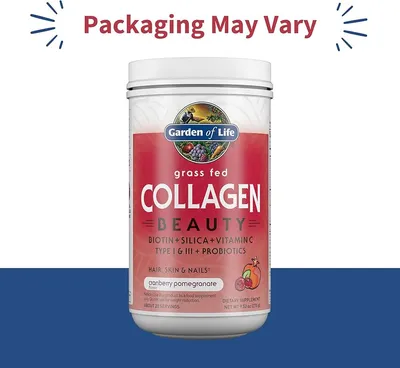
Garden of Life Grass Fed Collagen Beauty
Best organic collagen supplement — USDA certified, grass-fed sourcing, and a thoughtful formula that adds biotin and silica for comprehensive skin, hair, and nail support.
- USDA Organic and non-GMO Project Verified
- Grass-fed, pasture-raised bovine collagen (types I and III)
- Added biotin and plant-based silica for comprehensive beauty support
- No artificial flavors, sweeteners, or fillers
- Unflavored powder can have a mild taste some people notice
- 12g serving size is larger than some competitors
- Bovine source not suitable for pescatarians or those avoiding red meat products
Garden of Life Grass Fed Collagen Beauty is the best organic collagen supplement for adults over 50 who care about what goes into their body. It combines USDA Organic grass-fed bovine collagen peptides with biotin and plant-based silica — three ingredients that support skin elasticity, hair strength, and nail health through complementary mechanisms. In a collagen market crowded with questionable sourcing and vague claims, Garden of Life’s commitment to organic certification and clean ingredients sets it apart.
What Is Garden of Life Collagen Beauty?
Garden of Life has built its reputation on clean, certified supplements — they’re one of the few major brands that pursues USDA Organic certification across most of their product line. Their Collagen Beauty powder is sourced from pasture-raised, grass-fed cattle with no added hormones, antibiotics, or GMO feed. The USDA Organic seal on a collagen supplement is genuinely rare, because certifying the entire supply chain from farm to finished product is expensive and logistically demanding.
The product goes beyond basic collagen peptides by including biotin (1,500mcg) and silica from organic plant sources. This “beauty formula” approach targets the three most common age-related concerns women over 50 report: thinning skin, weakening hair, and brittle nails. Rather than asking you to buy three separate supplements, Garden of Life addresses all three in one daily scoop.
The brand is now owned by Nestlé Health Science, which has brought additional manufacturing resources while maintaining Garden of Life’s commitment to organic and non-GMO standards. Products continue to be third-party certified.
What’s Inside
Each one-scoop (12g) serving provides:
- 12g collagen peptides — from grass-fed, pasture-raised bovine hide (types I and III collagen)
- 1,500mcg biotin (5,000% DV) — supports keratin production for hair and nail strength
- Plant-based silica — from organic bamboo extract, supports collagen cross-linking
The collagen is hydrolyzed into peptides, meaning the protein chains are broken down into smaller fragments that dissolve in liquids and are more readily absorbed. The amino acid profile is rich in glycine, proline, and hydroxyproline — the three amino acids most critical for collagen synthesis in your body.
Certifications: USDA Organic, non-GMO Project Verified, NSF Gluten-Free, Keto Certified, Paleo Friendly. No artificial flavors, colors, sweeteners, or preservatives. The powder is unflavored, designed to blend into any beverage without altering the taste significantly.
What the Research Says
Collagen supplementation for skin health has a growing evidence base. A 2019 meta-analysis of 11 randomized controlled trials involving 805 participants found that hydrolyzed collagen supplementation significantly improved skin hydration, elasticity, and wrinkle depth compared to placebo. The review concluded that results were typically visible after 8-12 weeks of daily supplementation at doses of 2.5-10g.
A 2014 study in Skin Pharmacology and Physiology gave women aged 35-55 either 2.5g or 5g of collagen peptides daily for 8 weeks. Both groups showed statistically significant improvements in skin elasticity compared to placebo, with the greatest benefit in women over 50 — exactly the demographic where natural collagen production has declined most.
For the biotin component, a 2017 review in Skin Appendage Disorders analyzed 18 cases of biotin supplementation for brittle nails and hair loss. While the authors noted that strong evidence exists primarily in cases of biotin deficiency, clinical improvement was observed in the majority of cases, with nail thickness increasing by up to 25%. Subclinical biotin deficiency is more common than many realize, particularly in older adults.
Silica’s role in connective tissue health was highlighted in a 2005 randomized controlled trial that found orthosilicic acid supplementation improved skin surface roughness, hair brittleness, and nail quality in women with photodamaged skin. Silica is required for the enzyme prolyl hydroxylase, which is essential for collagen synthesis.
Who Is This Best For?
Garden of Life Collagen Beauty is a particularly good fit for:
- Women over 50 who prioritize organic, clean-label supplements and want to minimize exposure to pesticides, hormones, and antibiotics in their collagen source
- Anyone experiencing age-related changes in skin, hair, or nails who wants a comprehensive formula rather than collagen alone
- People who prefer powder format — it’s easy to add to morning coffee, tea, or smoothies as part of an existing routine
- Those who want both type I and type III collagen for broad connective tissue support, not just skin
This may not be the best fit if you’re pescatarian or avoid bovine products (marine collagen like Further Food is a better option), if you dislike mixing powders into beverages (capsule-form collagen supplements exist, though at lower doses), or if you want a flavored collagen product (this is unflavored — some people detect a mild taste in plain water).
How to Take It
Mix one scoop into 8 ounces of your preferred liquid. The powder dissolves best in warm beverages — coffee and tea are popular choices. It also works in smoothies, oatmeal, or soup. In cold water, you may need to stir more vigorously or use a shaker bottle.
Timing tip: Some research suggests taking collagen on an empty stomach may improve peptide absorption. If that’s practical for you, try mixing it into a glass of water 30 minutes before breakfast. If not, taking it with food — especially foods containing vitamin C — is perfectly fine. Vitamin C is a cofactor for collagen synthesis, so pairing your collagen with a vitamin C source (citrus, berries, bell peppers) may enhance the benefits.
Consistency matters more than timing. The clinical trials showing skin improvements required 8-12 weeks of daily use. Pick a time that fits your routine and stick with it.
Interactions to watch: Collagen peptides are generally very safe with minimal drug interactions. The biotin content (1,500mcg) is worth noting — high-dose biotin can interfere with certain lab tests, including thyroid panels and troponin (heart attack marker) tests. If you’re getting blood work done, mention your biotin intake to your doctor and consider pausing supplementation 48-72 hours before testing.
Consult your doctor before starting any new supplement regimen, particularly if you have food allergies, are pregnant, or take medications that affect protein metabolism.
The Bottom Line
Garden of Life Grass Fed Collagen Beauty earns a 4.3 rating for delivering what most collagen supplements promise but few actually certify: verifiably clean sourcing backed by the USDA Organic seal. The addition of biotin and plant-based silica makes it a more complete beauty formula than collagen peptides alone, addressing skin, hair, and nail health through three complementary ingredients. At roughly $30 for a 20-serving container, the per-serving cost is competitive with premium collagen brands. For women over 50 who want organic certification, grass-fed sourcing, and a comprehensive beauty formula in one daily scoop, this is our top recommendation in the clean collagen category.
Frequently Asked Questions
Why does Garden of Life use grass-fed bovine collagen instead of marine collagen?
Grass-fed bovine collagen provides both type I and type III collagen — the two types most abundant in skin, tendons, and bone. Marine collagen provides primarily type I. For skin health specifically, both work well, but the combination of type I and III in bovine collagen may offer broader connective tissue support. Garden of Life sources from pasture-raised, grass-fed cattle with no added hormones or antibiotics, and the USDA Organic certification verifies that the sourcing chain meets strict federal standards.
What makes this collagen USDA Organic when most collagens are not?
Achieving USDA Organic certification for a collagen supplement is difficult because it requires the entire supply chain — from the cattle's feed and living conditions through processing — to meet organic standards. Most collagen brands skip this step because it's expensive and logistically complex. Garden of Life invested in certifying their bovine sourcing and manufacturing process. The result is one of very few collagen supplements that carries the USDA Organic seal, which matters if you're trying to minimize your exposure to pesticides, hormones, and antibiotics.
Does adding biotin and silica actually improve collagen results?
There's reasonable science supporting the combination. Biotin (vitamin B7) is essential for keratin production — the protein that forms hair and nails. A 2017 review in Skin Appendage Disorders found that biotin supplementation improved nail and hair quality in people with biotin deficiency. Silica is a trace mineral involved in collagen synthesis itself — your body needs it to cross-link collagen fibers properly. A 2005 study found that orthosilicic acid supplementation improved skin roughness and hair brittleness. Combined with collagen peptides, these ingredients address beauty from multiple angles.
How should I take Garden of Life Collagen Beauty for best results?
Mix one scoop (12g) into 8 ounces of water, coffee, tea, or a smoothie. The powder is unflavored and dissolves reasonably well in hot or cold liquids, though it blends best in warm beverages. Take it daily on a consistent basis — collagen research typically shows visible results after 8-12 weeks of daily use. Some people prefer taking collagen on an empty stomach for better absorption, though taking it with vitamin C-rich foods (orange juice, berries) may enhance collagen synthesis.