
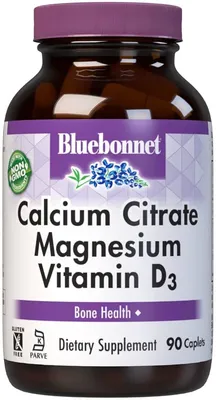
Bluebonnet Calcium Citrate Magnesium Plus Vitamin D3
Best value all-in-one bone mineral formula — delivers calcium citrate, magnesium, and D3 in a clean, kosher-certified product at a very reasonable price point.
- Chelated calcium citrate — absorbed well even with low stomach acid or PPI use
- Full 400mg magnesium dose included for vitamin D activation and bone matrix support
- Kosher certified, non-GMO, soy-free, gluten-free
- Affordable all-in-one bone mineral formula at ~$18
- Four caplets daily — moderate pill burden
- Does not include vitamin K2 — consider adding a separate K2 supplement
- Magnesium component uses partly magnesium oxide (less bioavailable form)
Bluebonnet Calcium Citrate Magnesium Plus Vitamin D3 is a straightforward, well-executed bone mineral formula that delivers the three foundational nutrients for bone health — calcium, magnesium, and vitamin D3 — in clean, well-absorbed forms. At around $18 a bottle, it offers strong value for adults over 50 who want a single product to cover their core bone nutrition without the premium price tag of boutique brands.
What Is Bluebonnet Calcium Citrate Magnesium D3?
Bluebonnet Nutrition has been manufacturing supplements in Sugar Land, Texas since 1991. They occupy a respected middle ground in the supplement industry — more transparent and quality-focused than drugstore brands, but more affordable than clinical-tier companies like Thorne or Pure Encapsulations. Their manufacturing facility carries NSF GMP registration, and they hold kosher certification from the KOF-K, one of the most recognized kosher certifying agencies in the world.
This calcium-magnesium-D3 formula reflects Bluebonnet’s practical approach to supplementation. Rather than loading up on trendy extras, they focused on getting the core bone minerals right — using chelated calcium citrate instead of cheap calcium carbonate, including a meaningful dose of magnesium, and adding vitamin D3 to tie the whole formula together. The result is a no-nonsense bone supplement that does exactly what it advertises.
The product is free from soy, gluten, milk, egg, fish, and shellfish. It carries non-GMO verification and is suitable for vegetarians.
What’s Inside
Each four-caplet daily serving provides:
- Calcium (1,000mg as calcium citrate) — the chelated form that absorbs independently of stomach acid, making it ideal for adults over 50 whose acid production has naturally declined
- Magnesium (400mg from magnesium aspartate and magnesium oxide) — required for vitamin D activation and bone matrix integrity; this dose meets the full female RDA
- Vitamin D3 (800 IU / 20mcg) — drives calcium absorption from the intestine; sourced from lanolin (sheep’s wool), a common and effective D3 source
The calcium citrate choice is the smart decision here. After age 50, stomach acid production drops significantly. Calcium carbonate (the form in most cheap supplements) needs acid to dissolve and absorb. Calcium citrate dissolves readily in any pH environment, which means reliable absorption regardless of your digestive status. This is especially important if you take proton pump inhibitors like omeprazole or antacids.
The magnesium dose is genuinely useful — not a token amount. At 400mg, it covers the full RDA for women and nearly all of it for men. This matters because magnesium is required to convert vitamin D into its active form (calcitriol), and without adequate magnesium, your vitamin D supplementation becomes less effective at driving calcium absorption.
One notable absence: vitamin K2. Bluebonnet covers the calcium-absorption side of the equation (calcium + D3 + magnesium) but doesn’t include K2, which directs calcium into bones and away from arteries. If you choose this product, adding a separate K2 supplement is worth considering.
What the Research Says
The calcium citrate versus carbonate debate is settled for adults over 50. A study published in the Journal of Clinical Pharmacology (1999) compared the two forms and found that calcium citrate delivered 22-27% higher bioavailability than calcium carbonate, with the gap widening further when taken without food. For older adults, whose stomach acid production may be a fraction of what it was at age 30, this difference is clinically meaningful.
Magnesium’s role in bone health has gained increasing recognition. A 2013 study in Nutrients found that magnesium intake was significantly associated with bone mineral density in both men and women, independent of calcium and vitamin D intake. The National Health and Nutrition Examination Survey (NHANES) data suggests that roughly 50% of Americans over 50 consume less than the Estimated Average Requirement for magnesium — making supplementation particularly relevant for this population.
The vitamin D3 dose of 800 IU aligns with the recommendation from the National Osteoporosis Foundation and the 2010 Institute of Medicine guidelines for adults over 50. A meta-analysis in the New England Journal of Medicine (2012) found that daily vitamin D supplementation of 800 IU or more reduced hip fracture risk by approximately 30% in adults over 65. Some researchers argue that higher doses (1,000-2,000 IU) may be optimal, particularly for those with documented vitamin D deficiency.
Who Is This Best For?
Bluebonnet Calcium Citrate Magnesium D3 is an excellent choice if you:
- Take acid-reducing medication (PPIs, H2 blockers, or antacids) — the calcium citrate form absorbs without stomach acid, unlike calcium carbonate
- Want a complete bone mineral formula in one product — calcium, magnesium, and D3 together eliminates the need to buy and coordinate three separate supplements
- Follow kosher dietary laws — the KOF-K certification is recognized and trusted
- Are budget-conscious — at roughly $18 per bottle, this is one of the most affordable quality bone formulas available
- Have digestive sensitivity to calcium — calcium citrate causes significantly less bloating, gas, and constipation than calcium carbonate
Consider a different product if: you want vitamin K2 included (Thorne Basic Bone Nutrients has K2 built in), you want the lowest possible pill count (Citracal Maximum Plus D3 uses two tablets), or you want plant-sourced calcium (New Chapter Bone Strength Take Care uses algae-derived calcium).
How to Take It
Take four caplets daily, ideally split into two doses of two caplets each. Your intestines absorb calcium most efficiently in doses of 500mg or less, so splitting the 1,000mg total dose in half makes a real difference.
Timing suggestion: Two caplets with breakfast and two with dinner. The calcium citrate can be taken with or without food, but the fat-soluble vitamin D3 absorbs better with a meal containing some dietary fat.
Drug interactions to watch: Space this supplement at least 2-4 hours from thyroid medication (levothyroxine), bisphosphonates (alendronate, risedronate), tetracycline and fluoroquinolone antibiotics, and certain blood pressure medications. Calcium and magnesium can reduce the absorption of these drugs.
The magnesium component may have a mild laxative effect at 400mg, particularly when you first start taking it. This usually resolves within a week. If loose stools persist, try splitting the dose further or taking all four caplets with food.
The Bottom Line
Bluebonnet Calcium Citrate Magnesium D3 does the fundamentals right at a fair price. The chelated calcium citrate ensures reliable absorption even with reduced stomach acid, the 400mg magnesium dose is genuinely therapeutic (not a token sprinkle), and the D3 ties the absorption pathway together. It lacks vitamin K2 — a meaningful omission that you can address with a separate supplement — but as a core bone mineral formula, it delivers excellent value. For adults over 50 who want a clean, kosher, well-absorbed bone supplement without paying premium prices, Bluebonnet earns a confident recommendation.
Always consult your doctor before starting any bone health supplement, especially if you take prescription medications, have kidney disease, or are being treated for osteoporosis.
Frequently Asked Questions
Why does Bluebonnet use calcium citrate instead of calcium carbonate?
Calcium citrate is absorbed 22-27% more efficiently than calcium carbonate in people with low stomach acid — a common condition in adults over 50, since stomach acid production naturally declines with age. Calcium citrate also doesn't require food for absorption and causes fewer digestive side effects like bloating and constipation. A study in the Journal of Clinical Pharmacology found that calcium citrate provided significantly higher calcium bioavailability than carbonate, particularly when taken on an empty stomach.
How much magnesium does the Bluebonnet formula provide?
Each four-caplet daily serving provides 400mg of magnesium from magnesium aspartate and magnesium oxide. This meets the full RDA for women over 50 (320mg) and comes close to the male RDA (420mg). Magnesium is critical for bone health because it's required to convert vitamin D to its active form (calcitriol), and roughly 60% of your body's magnesium is stored in bone tissue. Studies suggest that magnesium deficiency — which affects an estimated 50% of Americans — may be an independent risk factor for osteoporosis.
Can I take Bluebonnet Calcium Citrate Magnesium D3 if I'm on a PPI like omeprazole?
Yes, and this is one of the key reasons to choose calcium citrate over calcium carbonate. PPIs (proton pump inhibitors) reduce stomach acid, which impairs calcium carbonate absorption since carbonate requires acid to dissolve. Calcium citrate does not depend on stomach acid, so it remains well-absorbed even with long-term PPI use. If you take omeprazole, pantoprazole, or esomeprazole regularly, a citrate-based calcium formula like Bluebonnet is the right call.
Is Bluebonnet a trustworthy supplement brand?
Bluebonnet has been manufacturing supplements in Sugar Land, Texas since 1991 and has built a strong reputation in the natural products industry. Their manufacturing facility is NSF GMP-registered, meaning it meets strict Good Manufacturing Practice standards. They hold kosher certification from the KOF-K, non-GMO verification, and their products are regularly tested for purity and potency. Among pharmacists and health food store staff, Bluebonnet is consistently rated as a reliable, mid-tier brand that offers good quality without premium pricing.