
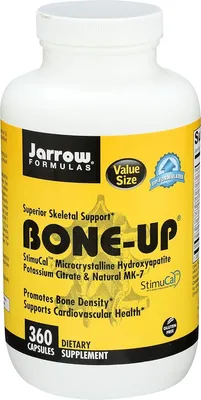
Jarrow Formulas Bone-Up
Best bone-specific calcium formula — the MCHA-plus-MBP combination provides the most biologically targeted approach to bone support, ideal for adults over 50 who want their calcium in the form bones actually use.
- MCHA calcium — the actual form found in living bone tissue, not limestone or chemical chelates
- Includes MBP (milk basic protein) at clinically studied 40mg dose
- Vitamin K2 as MK-7 (MenaQ7) — the long-acting form with 72-hour half-life
- Well-researched formula with published clinical support for each ingredient
- Six capsules per day for full dose — high pill burden
- Bovine-sourced MCHA — not suitable for vegetarians or those with dairy allergies
- Contains vitamin K2 — requires medical clearance if taking warfarin
Jarrow Formulas Bone-Up is one of the most scientifically distinctive bone supplements on the market, built around microcrystalline hydroxyapatite (MCHA) — the same calcium-phosphorus matrix that makes up your actual bone tissue. Combined with MBP (milk basic protein), vitamin D3, and vitamin K2 as MK-7, it takes a targeted approach that standard calcium pills simply cannot match. For adults over 50 serious about maintaining bone density, Bone-Up represents a research-backed step above commodity calcium.
What Is Jarrow Bone-Up?
Jarrow Formulas has been manufacturing supplements in Los Angeles since 1977, earning a reputation for science-driven formulations that often lead the market by years. They were among the first U.S. companies to use microcrystalline hydroxyapatite as a calcium source, recognizing that the form of calcium matters just as much as the dose.
Bone-Up reflects Jarrow’s philosophy of ingredient specificity. Rather than using the cheapest calcium source available (calcium carbonate, which is essentially ground limestone), they chose MCHA — calcium in the exact structural matrix your bones are made of. Then they added MBP, a milk-derived protein fraction that research suggests actively supports the bone-building process. This isn’t just a calcium delivery system. It’s a formula designed to work with your body’s own bone metabolism.
The product has been through multiple reformulations over the years, with each version incorporating the latest research. The current version includes MenaQ7-branded vitamin K2 as MK-7, the most clinically studied long-acting form of K2 available.
What’s Inside
Each six-capsule daily serving provides:
- Microcrystalline hydroxyapatite (MCHA) (1,000mg yielding calcium, phosphorus, type I collagen, and bone growth factors) — calcium in its bone-native form, sourced from young, free-range Australian and New Zealand bovine bone
- MBP (milk basic protein) (40mg) — a specialized whey protein fraction that may stimulate osteoblast (bone-building cell) activity
- Vitamin D3 (1,000 IU / 25mcg) — essential for intestinal calcium absorption
- Vitamin K2 (45mcg as MK-7, MenaQ7 brand) — activates osteocalcin to deposit calcium into bone and activates matrix GLA protein to keep calcium out of arteries
- Vitamin C (100mg) — required for collagen synthesis, the protein scaffold of bone
MCHA is fundamentally different from other calcium sources. Calcium carbonate is powdered limestone. Calcium citrate is a chemical chelate. MCHA is actual bone tissue, freeze-dried and processed at low temperatures to preserve its natural collagen and growth factor content. Your body doesn’t just get calcium — it gets the full blueprint of bone mineral in its native architecture.
The capsules use a standard gelatin shell (bovine-derived). This product is not vegetarian.
What the Research Says
The evidence for MCHA over conventional calcium forms is meaningful. A randomized controlled trial published in the International Journal of Osteoporosis (1995) compared MCHA with calcium carbonate in postmenopausal women and found that the MCHA group maintained bone mineral density significantly better over two years, while the calcium carbonate group continued to lose bone.
MBP has its own clinical support. A study in Bioscience, Biotechnology, and Biochemistry (2007) found that 40mg of MBP daily — the same dose in Bone-Up — increased bone mineral density in healthy women over a six-month supplementation period. The mechanism appears to involve stimulation of osteoblast proliferation and suppression of osteoclast activity, essentially tipping the bone remodeling balance toward building rather than breakdown.
The MenaQ7 form of vitamin K2 (MK-7) has a biological half-life of approximately 72 hours, compared to just 1-2 hours for MK-4. This means a single daily dose maintains effective blood levels around the clock. A three-year randomized, double-blind, placebo-controlled trial published in Osteoporosis International (2013) found that 180mcg of MenaQ7 MK-7 daily significantly improved bone strength and reduced age-related bone loss at the femoral neck and lumbar spine.
Vitamin C’s role in bone health is often overlooked. A 2015 analysis in Nutrients reviewing 13 observational studies found a significant positive association between vitamin C intake and bone mineral density. Collagen makes up roughly 90% of the organic matrix of bone, and vitamin C is essential for collagen synthesis.
Who Is This Best For?
Jarrow Bone-Up is ideal for adults over 50 who:
- Want the most bone-targeted calcium form available — MCHA provides calcium in its native bone matrix, not as limestone or a synthetic chelate
- Are willing to take six capsules daily for a comprehensive formula — this is a commitment, but it allows therapeutic doses without giant tablets
- Have been diagnosed with osteopenia or early osteoporosis and want aggressive nutritional support alongside their medical treatment
- Tolerate dairy products — both MCHA and MBP are animal-derived
- Prefer long-acting vitamin K2 — the MK-7 form needs only one daily dose to maintain effective levels
This is not the right product if: you’re vegetarian, have a dairy allergy, take warfarin (the K2 requires medical clearance), or want the fewest possible pills. For a lower pill burden with comprehensive nutrients, Thorne Basic Bone Nutrients uses four capsules daily. For a plant-sourced calcium, look at New Chapter Bone Strength Take Care.
How to Take It
Take six capsules daily, ideally split into two doses of three capsules each — one with breakfast and one with dinner. Splitting the dose improves calcium absorption, since your intestines can only efficiently absorb about 500mg of calcium at a time.
Take with food. The fat-soluble vitamins D3 and K2 absorb significantly better with dietary fat. A meal containing even a small amount of fat (eggs, avocado, olive oil on a salad) makes a measurable difference.
Drug interactions to watch: Vitamin K2 interacts with warfarin — do not combine without your doctor’s approval and monitoring. Space Bone-Up at least 2-4 hours from thyroid medication (levothyroxine), bisphosphonates (alendronate, risedronate), tetracycline antibiotics, and fluoroquinolone antibiotics. Calcium reduces the absorption of all of these.
If you take a proton pump inhibitor (omeprazole, pantoprazole) or H2 blocker (famotidine), MCHA has an advantage over calcium carbonate — its absorption does not depend on stomach acid levels.
The Bottom Line
Jarrow Bone-Up is the most bone-specific calcium supplement available, using the actual mineral matrix found in living bone tissue rather than a generic calcium salt. The combination of MCHA, clinically dosed MBP, vitamin D3, K2 (MK-7), and vitamin C addresses multiple pathways in bone metabolism — from calcium absorption and deposition to collagen synthesis and bone cell activity. The six-capsule daily dose and bovine sourcing won’t suit everyone, but for adults over 50 who want their bone supplement rooted in what bones are actually made of, Bone-Up delivers where generic calcium cannot.
Always consult your doctor before starting any bone health supplement, especially if you take blood thinners, have kidney disease, or are being treated for osteoporosis.
Frequently Asked Questions
What is microcrystalline hydroxyapatite and why is it better than regular calcium?
Microcrystalline hydroxyapatite (MCHA) is calcium in the same structural form your bones are actually made of — a matrix of calcium, phosphorus, collagen, and growth factors extracted from young bovine bone. Unlike calcium carbonate (limestone) or calcium citrate (a chemical chelate), MCHA provides the full spectrum of bone minerals in their natural ratios. Clinical studies published in the International Journal of Osteoporosis suggest that MCHA may support bone density more effectively than calcium carbonate, possibly because your body recognizes and incorporates the familiar structure more readily.
What is MBP in Jarrow Bone-Up and what does it do?
MBP stands for milk basic protein, a specialized fraction of whey protein that research suggests may stimulate bone-building cells (osteoblasts) while reducing the activity of bone-resorbing cells (osteoclasts). A 2007 study in Bioscience, Biotechnology, and Biochemistry found that MBP supplementation increased bone mineral density in healthy young women over six months. Jarrow includes a clinically studied dose of 40mg MBP per serving — the same amount used in the published research.
Can I take Jarrow Bone-Up if I'm lactose intolerant?
MCHA and MBP are both derived from bovine sources (bone and milk, respectively), but the processing removes virtually all lactose. Most lactose-intolerant users tolerate Bone-Up without issues. However, if you have a true dairy allergy (not just intolerance), the trace milk proteins present could trigger a reaction. In that case, a plant-sourced calcium like Garden of Life mykind Organics Plant Calcium would be safer.
How does Jarrow Bone-Up compare to Thorne Basic Bone Nutrients?
Both are premium bone formulas, but they take different approaches. Thorne uses calcium citrate-malate with magnesium, D3, K2 (MK-4), and boron — a comprehensive mineral team. Jarrow uses MCHA calcium (the actual bone matrix) with MBP, D3, and K2 (MK-7) — a more bone-specific approach. Thorne is the better all-around formula if you also need magnesium. Jarrow is the stronger choice if you want the most bone-targeted calcium form available. Both are excellent; your choice depends on whether you prefer breadth (Thorne) or bone specificity (Jarrow).