
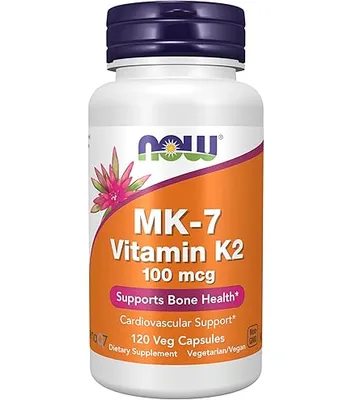
NOW Foods Vitamin K2 MK-7 100mcg
Best standalone vitamin K2 for bone health — the MenaQ7 form, clinically backed dose, and low price make this the essential add-on to any calcium/D3 regimen that lacks K2.
- Uses MenaQ7 — the clinically studied, patented MK-7 form with published bone density data
- Long 72-hour half-life means a single daily capsule maintains effective blood levels
- Excellent value at ~$14 for 60 capsules (2-month supply)
- Essential safety complement to calcium supplementation — directs calcium away from arteries
- Contraindicated with warfarin without medical supervision
- Does not contain calcium or D3 — must be taken alongside other bone supplements
- Softgel contains soy (soy lecithin in the base)
NOW Foods Vitamin K2 MK-7 100mcg may be the most important bone supplement that most people over 50 have never heard of. While calcium and vitamin D get all the attention, vitamin K2 is the traffic controller — the nutrient that activates the proteins responsible for directing calcium into your bones and keeping it out of your arteries. At around $14 for a two-month supply, this is the highest-impact, lowest-cost addition you can make to a bone health regimen.
What Is NOW Foods Vitamin K2 MK-7?
NOW Foods has been a family-owned supplement company based in Bloomingdale, Illinois since 1968. They’ve built their reputation on making research-backed supplements accessible — good quality at prices that don’t require a second mortgage. Their manufacturing facilities are GMP-certified and regularly audited.
This product delivers 100mcg of vitamin K2 in the MK-7 (menaquinone-7) form, specifically using MenaQ7 — the patented, clinically studied MK-7 produced by NattoPharma. MenaQ7 is not just any MK-7. It’s the exact form used in the landmark three-year bone density trial that put vitamin K2 on the map for bone health researchers. When you see MenaQ7 on a label, you know the manufacturer is using the ingredient with the strongest clinical backing.
The distinction between K2 and its better-known cousin K1 is critical. Vitamin K1 (abundant in leafy greens) primarily handles blood clotting. Vitamin K2, particularly the MK-7 form, has a different job — it activates the calcium-regulating proteins that determine whether calcium strengthens your bones or hardens your arteries. Most adults over 50 get adequate K1 from diet but are profoundly deficient in K2.
What’s Inside
Each softgel capsule provides:
- Vitamin K2 (100mcg as MK-7, MenaQ7 brand) — the long-acting form that maintains effective blood levels for approximately 72 hours after a single dose
The supporting ingredients include extra virgin olive oil (as the carrier fat for absorption), softgel capsule (bovine gelatin, glycerin, water), and soy lecithin.
The formula is deliberately simple — one active ingredient, well-dosed, in a fat-based carrier for optimal absorption. Vitamin K2 is fat-soluble, and the olive oil base ensures it absorbs efficiently even if you take it between meals.
To understand why K2 matters so much, consider what happens without it. Calcium enters your bloodstream (thanks to vitamin D), but your body needs activated osteocalcin to grab that calcium and lock it into bone tissue. Osteocalcin requires vitamin K2 to become active. Without K2, osteocalcin stays inactive, calcium floats past your bones, and much of it ends up deposited in arterial walls, heart valves, and kidneys. This is why some large studies found that calcium supplementation without K2 may actually increase cardiovascular risk — the calcium had nowhere productive to go.
What the Research Says
The evidence for vitamin K2 MK-7 in bone health is substantial and growing. The most important trial was a three-year randomized, double-blind, placebo-controlled study published in Osteoporosis International (2013) involving 244 postmenopausal women. Women receiving 180mcg of MenaQ7 MK-7 daily showed significantly improved bone mineral content, bone mineral density, and bone strength at the femoral neck and lumbar spine compared to placebo. The treated group also showed significantly less age-related decline in vertebral height — a measure of compression fracture risk.
On the cardiovascular side, the Rotterdam Study — a large population-based study published in the Journal of Nutrition (2004) — followed over 4,800 subjects for 10 years and found that those with the highest vitamin K2 intake had a 57% lower risk of dying from coronary heart disease and a 26% lower risk of dying from any cause. The researchers attributed this primarily to K2’s role in preventing arterial calcification via matrix GLA protein activation.
A mechanistic study in Blood (2007) confirmed that vitamin K2 activates matrix GLA protein (MGP), the most potent natural inhibitor of vascular calcification known. Without K2, MGP remains inactive, and calcium freely deposits in arterial walls. This is the biological link between K2 deficiency, bone loss, and cardiovascular disease — they share a common mechanism.
The Rotterdam findings were later supported by the Prospect-EPIC cohort study published in Nutrition, Metabolism, and Cardiovascular Diseases (2009), which followed over 16,000 women and found that each 10mcg increase in vitamin K2 intake was associated with a 9% reduction in coronary heart disease risk. K1 intake showed no such association.
Who Is This Best For?
NOW Foods Vitamin K2 MK-7 is essential for adults over 50 who:
- Take calcium and vitamin D3 but no K2 — this is the most common gap in bone supplement regimens, and potentially the most dangerous one
- Are concerned about arterial calcification — if you’ve had a coronary calcium score done or have cardiovascular risk factors, K2 addresses the calcium-in-arteries concern directly
- Use a calcium supplement that doesn’t include K2 — products like Citracal, Nature Made Calcium, or Bluebonnet Calcium Citrate Magnesium D3 all lack K2
- Want the clinically studied form — MenaQ7 is the MK-7 with the published bone density data, not a generic equivalent
- Prefer simplicity — one small softgel, once daily, no complicated dosing schedule
Do not take this product if: you use warfarin (Coumadin) without first consulting your doctor. K2 directly opposes warfarin’s mechanism of action and will alter your INR. Newer anticoagulants (Eliquis, Xarelto, Pradaxa) are generally not affected, but always verify with your prescribing physician.
If you’d rather get K2 built into your bone formula, Thorne Basic Bone Nutrients includes K2 (as MK-4) alongside calcium, magnesium, and D3 in one product.
How to Take It
Take one softgel daily with a meal containing fat. The olive oil base provides some fat for absorption, but taking it alongside dietary fat (eggs, cheese, salad with dressing, avocado) optimizes uptake.
Timing: Morning or evening — the 72-hour half-life means timing is flexible. Just pick a consistent time so you don’t forget.
Can you take more than 100mcg? Yes. The bone density study used 180mcg daily, and some practitioners recommend 200mcg for adults with documented bone loss. Taking two softgels (200mcg) is safe and within the studied range for people not on warfarin. There is no established tolerable upper intake level for vitamin K2.
Drug interactions: The critical interaction is with warfarin — do not combine without medical supervision and INR monitoring. K2 has no known interactions with calcium supplements, vitamin D, bisphosphonates, or other common medications in older adults. It can be taken at the same time as your other bone supplements.
The Bottom Line
Vitamin K2 is the missing piece in most bone health regimens, and NOW Foods delivers the gold-standard MenaQ7 form at a price that removes any excuse not to take it. If you supplement with calcium and vitamin D but skip K2, you’re leaving a critical gap — one that affects not just your bone density but your cardiovascular health. At roughly seven cents per day, this is the single highest-value addition most adults over 50 can make to their bone supplement routine. The only exception is anyone on warfarin, who must get medical clearance first.
Always consult your doctor before starting any new supplement, especially if you take blood thinners or prescription medications.
Frequently Asked Questions
Why do I need vitamin K2 if I already take calcium and vitamin D?
Calcium and vitamin D get calcium into your bloodstream, but they don't control where that calcium ends up. Without vitamin K2, calcium can deposit in your arteries, heart valves, and kidneys instead of your bones. Vitamin K2 activates two key proteins: osteocalcin (which binds calcium into bone matrix) and matrix GLA protein (which prevents calcium from accumulating in soft tissues). A 2004 study in the Journal of Nutrition found that higher vitamin K2 intake was associated with a 57% reduction in coronary heart disease risk — largely by preventing arterial calcification.
What is the difference between vitamin K1, K2 MK-4, and K2 MK-7?
Vitamin K1 (phylloquinone) comes from leafy greens and primarily supports blood clotting — it has minimal effect on bone and arterial health. Vitamin K2 comes in two main forms: MK-4 (short-acting, 1-2 hour half-life, needs multiple daily doses) and MK-7 (long-acting, approximately 72-hour half-life, effective with a single daily dose). MK-7 maintains higher and more stable blood levels than MK-4, which is why most bone health researchers now favor it. The MenaQ7 form used in NOW's product is the specific MK-7 that was used in the landmark 3-year clinical trial showing improved bone density.
Will vitamin K2 interfere with my blood thinner medication?
If you take warfarin (Coumadin), YES — vitamin K2 directly affects the same clotting pathway that warfarin works on, and adding K2 can reduce warfarin's effectiveness. Do not start K2 without your doctor adjusting your warfarin dose and monitoring your INR closely. However, newer blood thinners like apixaban (Eliquis), rivaroxaban (Xarelto), and dabigatran (Pradaxa) work through a different mechanism and are generally not affected by vitamin K. Always confirm with your prescribing doctor before combining any K vitamin with blood-thinning medication.
How much vitamin K2 should I take for bone health after 50?
The most-cited clinical research used doses of 90-180mcg of MK-7 daily. The 3-year study in Osteoporosis International that demonstrated improved bone mineral density and bone strength used 180mcg. NOW provides 100mcg per capsule, which falls in the middle of the therapeutic range and can easily be doubled to 200mcg if your doctor recommends it. There is no established upper intake level for vitamin K2, and doses up to 360mcg daily have been used in studies without adverse effects in people not taking warfarin.