
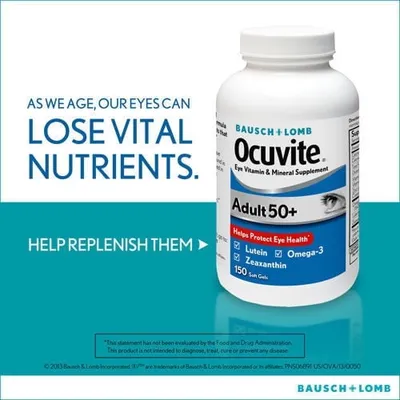
Bausch + Lomb Ocuvite Adult 50+
Best budget-friendly eye vitamin for adults over 50 who want general macular support without diagnosed AMD. The once-daily convenience and gentle formula make it easy to stick with long term.
- Affordable — roughly half the price of AREDS 2 supplements
- Convenient once-daily soft gel
- Includes omega-3 fatty acids alongside lutein and zeaxanthin
- Lower zinc dose (7.5mg) means fewer stomach issues and easier to combine with a multivitamin
- Lower lutein dose (6mg vs 10mg in AREDS2 trial)
- Not appropriate for diagnosed AMD — not the AREDS formula
- Omega-3 dose too low to meaningfully address dry eyes
Bausch + Lomb Ocuvite Adult 50+ is a solid general-purpose eye vitamin for adults who want everyday macular support without the high doses of the AREDS formula. It combines lutein, zeaxanthin, omega-3s, and zinc in a convenient once-daily soft gel at roughly half the price of PreserVision AREDS 2. For the majority of adults over 50 without an AMD diagnosis, this is a sensible and affordable option.
What Is Ocuvite Adult 50+?
Ocuvite is Bausch + Lomb’s mainstream eye vitamin line, and the Adult 50+ version is formulated specifically for the age group most concerned about long-term vision health. While PreserVision AREDS 2 (also from Bausch + Lomb) targets people already diagnosed with macular degeneration, Ocuvite 50+ is positioned for the much larger group of adults who want to support their eye health proactively.
The product has been on the market for over a decade and is one of the most widely sold eye supplements in the United States. You can find it at virtually every pharmacy, big box store, and online retailer. Bausch + Lomb, the company behind it, has been in the eye care business since 1853 — they make everything from contact lenses to surgical equipment.
Ocuvite 50+ takes a gentler, more balanced approach than AREDS formulas. Lower nutrient doses make it easier to tolerate, simpler to combine with other supplements, and more appropriate for people without clinical eye disease.
What’s Inside
Each soft gel contains:
- Lutein 6mg — The primary carotenoid in the macular pigment that filters blue light and protects photoreceptor cells. Sourced from FloraGLO lutein (marigold extract), the most clinically studied lutein ingredient.
- Zeaxanthin 1.2mg — The second carotenoid in the macular pigment, concentrated at the very center of the fovea where visual acuity is highest.
- Omega-3 fatty acids 150mg (from fish oil) — Includes EPA and DHA, which are structural components of retinal cell membranes.
- Zinc 7.5mg — Supports the metabolic activity of retinal enzymes. This dose is far lower than the 80mg in AREDS formulas, which makes it much easier on the stomach.
The formula also includes small amounts of vitamin C, vitamin E, and vitamin B complex. These are at modest levels — not the mega-doses found in AREDS products.
What the Research Says
The individual ingredients in Ocuvite 50+ all have research supporting their role in eye health, though the specific Ocuvite 50+ formula itself has not been tested in a dedicated large-scale clinical trial the way the AREDS formulas have.
Lutein and zeaxanthin are the most studied nutrients for macular health. A 2017 systematic review published in Nutrients analyzed 20 randomized controlled trials and found that lutein supplementation significantly increased macular pigment optical density (MPOD) — a biomarker associated with better visual function and lower AMD risk. Doses in these studies ranged from 6mg to 20mg daily, placing Ocuvite’s 6mg at the lower end but still within the effective range.
The omega-3 component is more nuanced. The AREDS2 trial itself tested omega-3 supplementation (1000mg DHA + EPA) and found no statistically significant benefit for AMD progression beyond the base AREDS formula. However, observational studies — including the Blue Mountains Eye Study published in Archives of Ophthalmology in 2009 — have found associations between higher dietary omega-3 intake and lower AMD incidence. The 150mg in Ocuvite is a modest dose, well below what those studies examined.
For general eye health maintenance rather than AMD treatment, the balance of evidence suggests these nutrients may help support macular pigment density over time. The key word is “may” — the evidence is suggestive, not definitive, at these dose levels.
Who Is This Best For?
Ocuvite Adult 50+ is a good fit if you:
- Are over 50 and want general eye health support but have not been diagnosed with AMD or other serious eye conditions
- Want a simple once-daily soft gel rather than managing multiple capsules throughout the day
- Take a daily multivitamin and need an eye supplement with lower doses that won’t create nutrient overlap problems
- Are budget-conscious and want a reliable eye vitamin from a trusted brand without paying premium prices
- Have a sensitive stomach — the lower zinc dose (7.5mg vs 80mg in AREDS formulas) is much less likely to cause nausea
This is probably not the right product if you:
- Have been diagnosed with intermediate or advanced AMD — your doctor will almost certainly recommend the AREDS2 formula instead
- Want a higher-potency lutein supplement — at 6mg, this is on the lower end of what studies have tested
- Need meaningful omega-3 support for dry eyes or cardiovascular health — the 150mg dose is too low to move the needle
How to Take It
Take one soft gel daily with a meal. Like all carotenoid supplements, lutein and zeaxanthin absorb much better with dietary fat. A meal containing healthy fats — eggs, avocado, olive oil, nuts — will maximize absorption.
There is no strong evidence favoring morning versus evening dosing. Pick whatever time you’ll remember consistently and pair it with an existing habit (breakfast, dinner, your other morning supplements).
Interaction note: The low doses in Ocuvite 50+ make drug interactions unlikely for most people. However, the vitamin E and omega-3 content could theoretically add a mild anticoagulant effect if you take blood thinners like warfarin. Mention it to your doctor at your next visit — this is a low-risk flag, not an emergency.
The Bottom Line
Ocuvite Adult 50+ does exactly what it promises: affordable, convenient, once-daily eye health support for adults over 50 who want to be proactive about their vision. It does not replace the AREDS2 formula for anyone with diagnosed macular degeneration, but for general maintenance, it is a practical choice backed by a reputable brand. At roughly $18 for a 50-day supply, the cost barrier is low enough to make this a sustainable long-term habit.
Always consult your doctor before starting any new supplement, especially if you have existing eye conditions or take prescription medications.
Frequently Asked Questions
Is Ocuvite 50+ the same as PreserVision AREDS 2?
No, they are different products from the same company. PreserVision AREDS 2 uses the exact high-dose formula from the NIH-funded AREDS2 clinical trial and is designed specifically for people with intermediate or advanced AMD. Ocuvite 50+ uses lower doses of lutein, zeaxanthin, and zinc, adds omega-3 fatty acids, and is designed for general eye health maintenance. If your ophthalmologist has diagnosed AMD, they will likely steer you toward PreserVision, not Ocuvite.
How much lutein is in Ocuvite 50+?
Ocuvite 50+ contains 6mg of lutein per soft gel. That is less than the 10mg used in the AREDS2 trial but within the range that research suggests may support macular pigment density over time. A 2017 review in the journal Nutrients found that lutein supplementation at doses ranging from 6mg to 20mg daily increased macular pigment optical density in most study participants.
Can I take Ocuvite 50+ with my multivitamin?
Generally yes, with less concern than PreserVision. Ocuvite 50+ contains moderate doses — 6mg lutein, 150mg omega-3s, and only 7.5mg zinc. These are unlikely to push you above tolerable upper limits when combined with a standard multivitamin. That said, always bring your full supplement list to your pharmacist or doctor for a quick overlap check.
Does Ocuvite 50+ help with dry eyes?
The omega-3 fatty acids in Ocuvite 50+ (150mg total) may provide some mild benefit for dry eye symptoms, but the dose is low compared to what dry eye studies typically use (1000-2000mg total omega-3s daily). If dry eyes are your primary concern, a dedicated high-potency omega-3 fish oil supplement alongside artificial tears is likely a more effective approach. Talk to your eye doctor about the right combination.