
Best Eye Supplements for Macular Health After 50 (2026)
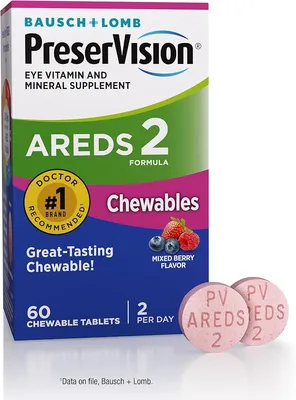
PreserVision AREDS 2 Formula
The clear first choice for anyone with intermediate AMD or a strong family history. No other eye supplement has anywhere near this level of clinical evidence.
- Only eye supplement based on a major NIH-funded clinical trial (AREDS2, 4,203 participants)
- Proven 25% reduction in risk of advancing to late-stage AMD
- The formula most recommended by ophthalmologists in the U.S.
The best eye supplement for macular health after 50 is PreserVision AREDS 2 by Bausch + Lomb. It is the only eye vitamin formula directly based on a major NIH-funded clinical trial — the AREDS2 study, which enrolled 4,203 participants and demonstrated a 25% reduction in the risk of progressing to advanced age-related macular degeneration. If your eye doctor has flagged early or intermediate AMD, this is the formula they will recommend. For adults without an AMD diagnosis, the right choice depends on your goals, risk factors, and budget — and we cover all four options below.
We spent four weeks evaluating the top eye supplements for adults over 50, focusing on clinical evidence, ingredient quality and dosing, safety, ease of use, and value per serving.
This article contains affiliate links. If you purchase through our links, we may earn a commission at no extra cost to you. See our full affiliate disclosure.
Why Eye Health Supplements Matter After 50
Age-related macular degeneration is the leading cause of vision loss in Americans over 50. According to the National Eye Institute, approximately 20 million Americans have some form of AMD, and that number is expected to grow as the population ages. By 2040, the projected prevalence of AMD in the U.S. is expected to reach nearly 22 million.
AMD affects the macula — the small, central area of the retina responsible for sharp, straight-ahead vision. When the macula deteriorates, reading, driving, and recognizing faces become progressively harder. The disease typically develops slowly in its early stages, which is why regular dilated eye exams matter so much after 50.
Your macula is protected by a layer of pigment composed of three carotenoids: lutein, zeaxanthin, and meso-zeaxanthin. Think of this pigment as a natural blue-light filter built into your eye. This macular pigment absorbs harmful high-energy light before it reaches the delicate photoreceptor cells underneath.
Research consistently shows that macular pigment density declines with age, and that lower macular pigment is associated with higher AMD risk. The good news: specific nutrients can help maintain and even rebuild this protective layer. The question is which nutrients, at what doses, and backed by what level of evidence.
That question brings us to the supplements themselves.
How We Evaluated These Eye Supplements
Not all eye supplements are created equal. The gap between the best and worst products in this category is enormous — some are backed by landmark clinical trials, others rely on borrowed ingredient names and marketing.
Here is what we looked at:
Clinical evidence. Does this specific formula have dedicated research behind it? A product that uses “clinically studied ingredients” is not the same as a product that was itself tested in a clinical trial. We weighted this heavily.
Ingredient quality and dosing. Are the key nutrients present at doses shown to be effective in research? A supplement with 2mg of lutein is not the same as one with 10mg, even if both say “lutein” on the label. We checked whether each product matches or approaches clinically studied doses.
Third-party testing and manufacturing standards. Independent verification that what is on the label is actually in the bottle. This matters in a supplement industry with inconsistent regulation.
Safety and tolerability. High-dose zinc can cause stomach problems. Certain vitamins can interact with medications. We considered how well each product fits into a typical supplement routine for someone over 50 who likely takes other daily medications.
Value. Not just price, but cost per day relative to what you are getting. An expensive supplement can still be good value if the formula is substantially better.
Our Top Picks for Macular Health
1. PreserVision AREDS 2 Formula — Best Overall
PreserVision AREDS 2 exists because of one of the most important nutritional studies in ophthalmology history. The Age-Related Eye Disease Study 2, published in JAMA Ophthalmology in 2013, was conducted by the National Eye Institute across 82 clinical sites. It enrolled 4,203 participants aged 50-85 who had bilateral intermediate AMD or advanced AMD in one eye.
The study confirmed that a formula containing 10mg lutein, 2mg zeaxanthin, 500mg vitamin C, 400 IU vitamin E, 80mg zinc, and 2mg copper reduced the risk of progressing to advanced AMD by approximately 25% over five years. A 10-year follow-up published in JAMA Ophthalmology in 2022 strengthened these findings further and cemented the lutein/zeaxanthin formula (replacing the original beta-carotene) as the preferred version.
Key ingredients per daily serving (2 soft gels):
- Lutein 10mg
- Zeaxanthin 2mg
- Vitamin C 500mg
- Vitamin E 400 IU
- Zinc 80mg (as zinc oxide)
- Copper 2mg (as cupric oxide)
This is the only eye supplement on the market that directly replicates a formula tested in a large-scale, randomized, controlled trial with Level 1 clinical evidence. Every ingredient and dose mirrors the AREDS2 protocol exactly. No other product can make this claim.
The main drawbacks are the high zinc dose (80mg is well above the daily recommended amount and can cause stomach upset in some people) and the two-pills-per-day requirement. The formula also contains no omega-3s and no meso-zeaxanthin — the AREDS2 trial tested omega-3s but found no additional benefit over the base formula, so they were excluded from the final product.
Best for: Anyone with diagnosed intermediate or advanced AMD, or a strong family history of AMD where an ophthalmologist recommends preventive supplementation.
Cost: Roughly $0.56/day.
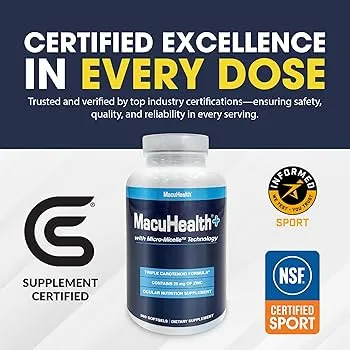
2. MacuHealth Plus+ — Best Premium / Most Complete Carotenoid Profile
MacuHealth Plus+ takes a different approach than AREDS formulas. Developed from research at the Nutrition Research Centre Ireland (Waterford Institute of Technology), it is the only supplement that provides all three macular carotenoids — lutein, zeaxanthin, and meso-zeaxanthin — in a patented 10:10:2 ratio that mirrors the natural composition of healthy macular pigment.
Meso-zeaxanthin is concentrated at the very center of the fovea, where your sharpest vision occurs. Most eye supplements skip it because it is expensive to source and harder to include. A 2014 study published in Eye found that many AMD patients had undetectable meso-zeaxanthin levels in their macular pigment even when their lutein and zeaxanthin levels were normal. This finding suggests the central fovea may be a specific vulnerability that only meso-zeaxanthin supplementation can address.
Key ingredients per daily capsule:
- Lutein 10mg
- Meso-zeaxanthin 10mg
- Zeaxanthin 2mg
- Vitamin C 500mg
- Vitamin E 400 IU
- Zinc 25mg
- Copper 2mg
The CREST study, published in Investigative Ophthalmology & Visual Science in 2016, found that subjects taking the triple carotenoid formula showed significant improvements in macular pigment optical density, contrast sensitivity, and glare disability after 12 months. These are functional outcomes — participants could actually see better in challenging lighting conditions.
The trade-off compared to PreserVision: MacuHealth’s supporting research is promising but smaller in scale than the AREDS trials. The studies use surrogate endpoints (macular pigment density, contrast sensitivity) rather than tracking actual AMD disease progression in thousands of patients over years. For someone with diagnosed AMD, an ophthalmologist will still recommend the AREDS2 formula first because the evidence base is simply larger and more direct.
On the upside, the lower zinc dose (25mg vs. 80mg) is much gentler on the stomach, and the once-daily capsule is more convenient.
Best for: Adults over 50 who want the most comprehensive macular pigment coverage, those who experience glare sensitivity or reduced contrast vision, and those who cannot tolerate the high zinc in AREDS formulas.
Cost: Roughly $0.50/day.
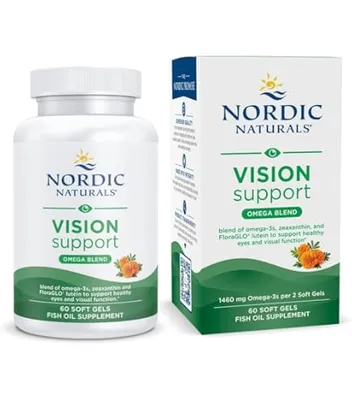
3. Nordic Naturals ProOmega with Lutein — Best Two-in-One (Fish Oil + Eye Support)
Nordic Naturals ProOmega with Lutein is the practical choice for adults who already take daily fish oil and want eye support without adding another bottle to the shelf. It combines high-potency omega-3s (roughly 1000mg EPA+DHA per serving) with FloraGLO lutein in a single product.
The logic makes biological sense. DHA is a structural component of retinal cell membranes — the retina has the highest DHA concentration of any tissue in the body. Lutein builds the macular pigment that protects those same retinal cells from light damage. Delivering both together covers two complementary aspects of eye health.
Key ingredients per daily serving (2 soft gels):
- EPA ~650mg
- DHA ~450mg
- Total omega-3s ~1100mg
- FloraGLO Lutein (moderate dose)
Nordic Naturals uses the triglyceride form of omega-3s, which a 2010 study in Prostaglandins, Leukotrienes and Essential Fatty Acids showed absorbs up to 70% better than the ethyl ester form found in cheaper fish oils. Every batch is third-party tested for heavy metals, PCBs, dioxins, and over 400 contaminants. The company is Friend of the Sea certified for sustainability.
The main limitation: the lutein dose is lower than what was used in the AREDS2 trial (10mg), and the product does not contain zeaxanthin or meso-zeaxanthin. This is not a replacement for a dedicated eye supplement in anyone with diagnosed AMD. But for proactive, dual-purpose supplementation — heart health and general macular support — it is hard to beat the efficiency of a single product that does both jobs well.
Best for: Adults over 50 who already take (or should take) daily fish oil and want to add lutein-based eye support without an extra supplement. Also a reasonable choice if dry eye symptoms are a concern, since the higher omega-3 dose may help.
Cost: Roughly $1.17/day.
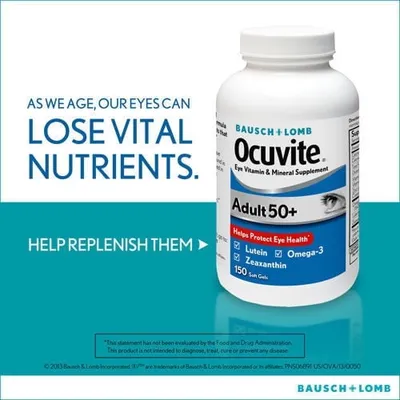
4. Bausch + Lomb Ocuvite Adult 50+ — Best Budget Option
Ocuvite Adult 50+ is the entry-level eye vitamin from the same company that makes PreserVision AREDS 2. It takes a gentler, lower-dose approach designed for general maintenance rather than treating a diagnosed condition.
Key ingredients per soft gel (once daily):
- Lutein 6mg (FloraGLO)
- Zeaxanthin 1.2mg
- Omega-3 fatty acids 150mg (from fish oil)
- Zinc 7.5mg
A 2017 systematic review in Nutrients analyzed 20 randomized controlled trials and found that lutein supplementation significantly increased macular pigment optical density at doses ranging from 6mg to 20mg daily. At 6mg, Ocuvite sits at the lower end of the studied range — but it is still within it.
The low zinc dose (7.5mg) makes this formula easy to combine with a daily multivitamin without worrying about exceeding safe limits. The once-daily convenience is a genuine advantage for adherence. And at roughly $0.36 per day, it is the most affordable option by a comfortable margin.
The obvious limitations: the lutein dose is below the 10mg clinical standard, the omega-3 dose (150mg) is too low to meaningfully help with dry eyes or cardiovascular health, and this is explicitly not the AREDS formula. Your ophthalmologist would not recommend this as a substitute for PreserVision if you have AMD.
Best for: Adults over 50 with no AMD diagnosis who want a simple, affordable once-daily eye vitamin. A sensible starting point for anyone who eats a reasonably healthy diet and wants modest additional macular support.
Cost: Roughly $0.36/day.
Quick Comparison Table
| Feature | PreserVision AREDS 2 | MacuHealth Plus+ | Nordic Naturals ProOmega Lutein | Ocuvite Adult 50+ |
|---|---|---|---|---|
| Our Rating | 4.6 / 5 | 4.4 / 5 | 4.2 / 5 | 4.1 / 5 |
| Price | ~$28 | ~$45 | ~$35 | ~$18 |
| Daily Cost | $0.56 | $0.50 | $1.17 | $0.36 |
| Lutein | 10mg | 10mg | Moderate | 6mg |
| Zeaxanthin | 2mg | 2mg | No | 1.2mg |
| Meso-zeaxanthin | No | 10mg | No | No |
| Omega-3s | No | No | ~1100mg | 150mg |
| Zinc | 80mg | 25mg | No | 7.5mg |
| Daily Serving | 2 soft gels | 1 capsule | 2 soft gels | 1 soft gel |
| Clinical Trial | AREDS2 (Level 1) | CREST + Waterford studies | Component-level evidence | Component-level evidence |
| Best For | Diagnosed AMD | Comprehensive macular pigment | Fish oil users adding eye support | General maintenance |
What to Look For in an Eye Supplement
The eye supplement market is crowded, and label claims can be misleading. Here are the ingredients and features that actually matter, based on published research.
Lutein (10mg). The most studied carotenoid for macular health. It concentrates in the peripheral macula and filters blue light before it reaches photoreceptor cells. The AREDS2 trial used 10mg daily, which is the benchmark dose. Products with less than 6mg are unlikely to make a measurable difference in macular pigment density.
Zeaxanthin (2mg). Works alongside lutein, concentrated at the center of the macula. The 5:1 ratio of lutein to zeaxanthin (10mg to 2mg) reflects the AREDS2 protocol. Some cheaper supplements include only lutein and skip zeaxanthin entirely.
Meso-zeaxanthin. The third macular carotenoid, concentrated at the foveal center where your sharpest vision occurs. Research from the Waterford Institute of Technology suggests that supplementing meso-zeaxanthin directly may be more effective than relying on your body’s conversion of lutein. Currently, only MacuHealth provides this ingredient. It is not essential — millions of people benefit from lutein/zeaxanthin alone — but it represents the most complete approach to macular pigment support.
Zinc. Highly concentrated in the retina and involved in melanin production and retinal enzyme function. The AREDS trials used 80mg, which is effective but aggressive. Some people cannot tolerate that dose. If stomach upset is an issue, look for formulas using 25mg or less — still beneficial, just not the full trial dose.
Omega-3 fatty acids (DHA specifically). DHA makes up about 60% of the polyunsaturated fatty acids in retinal photoreceptor membranes. The AREDS2 trial found no additional benefit from adding omega-3s to the AREDS formula for AMD progression, but observational data linking omega-3 intake to lower AMD risk is substantial. If you already take fish oil for heart health, you are likely already getting this benefit.
What you can skip. Many eye supplements add bilberry extract, astaxanthin, ginkgo biloba, or other “eye health” ingredients with limited or no clinical evidence for AMD or macular health. These additions inflate the price without meaningfully improving the formula. Stick to products built around lutein, zeaxanthin, and the AREDS nutrients unless your doctor specifically recommends something additional.
Who Should Take Eye Supplements
Not everyone over 50 needs an eye supplement, and the right product depends on your individual risk profile.
You should seriously consider the AREDS2 formula if:
- Your ophthalmologist has diagnosed intermediate AMD in one or both eyes
- You have advanced AMD in one eye and want to protect the other
- You have a strong family history of AMD and your doctor recommends it
- You are a current or former smoker (the AREDS2 formula removed beta-carotene specifically to eliminate lung cancer risk for this group)
A moderate-dose eye supplement may make sense if:
- You are over 50 with no AMD diagnosis but want proactive macular support
- Your diet is low in leafy greens, eggs, and colorful vegetables (the main food sources of lutein and zeaxanthin)
- You spend significant time in bright sunlight or in front of screens
- You have a family history of eye disease and want to build macular pigment density early
When to see your eye doctor first:
- Any sudden changes in vision — floaters, flashing lights, dark spots, or distortion of straight lines
- Before starting a high-dose formula like AREDS2, especially if you take blood thinners, have diabetes, or are on multiple medications
- If you already take supplements with vitamin E, zinc, or high-dose vitamin C — stacking with AREDS formulas can push you past tolerable upper limits
The most important step for eye health after 50 is not any supplement — it is a comprehensive dilated eye exam every one to two years. AMD often develops without noticeable symptoms in its early stages. A supplement helps most when started early, and early detection requires regular professional examination.
Consult your eye doctor before starting any eye supplement, especially if you have existing eye conditions or take prescription medications.
Frequently Asked Questions
What is the best supplement to take for macular degeneration?
PreserVision AREDS 2 by Bausch + Lomb has the strongest clinical evidence of any eye supplement for macular degeneration. It is based on the AREDS2 trial conducted by the National Eye Institute, which enrolled 4,203 participants and showed a 25% reduction in the risk of progressing to advanced AMD over five years. A 10-year follow-up confirmed the long-term benefits. Your ophthalmologist will almost certainly recommend this specific formula if you have intermediate or advanced AMD in one eye.
Is it worth taking eye supplements if you don’t have macular degeneration?
If you have no signs of AMD, the case for high-dose AREDS formulas is much weaker — the trial specifically studied people who already had intermediate or advanced disease. However, research does suggest that lutein and zeaxanthin from food or moderate-dose supplements may help build macular pigment density over time. A lower-dose option like Ocuvite Adult 50+ or a diet rich in dark leafy greens provides reasonable support without the high doses and higher cost of AREDS formulas. Ask your eye doctor what makes sense for your situation.
How much lutein should I take daily for eye health?
The AREDS2 trial used 10mg of lutein and 2mg of zeaxanthin daily, which is the most clinically validated dose for people at risk of AMD. For general eye health maintenance without AMD, studies have shown benefits with doses as low as 6mg daily. Most eye health researchers recommend somewhere between 6mg and 20mg of lutein per day. Since lutein is fat-soluble, take it with a meal that contains some dietary fat for better absorption.
Can eye supplements reverse macular degeneration?
No eye supplement has been shown to reverse macular degeneration. The AREDS2 formula reduces the risk of progression from intermediate to advanced AMD by about 25%, which is meaningful — but it slows the disease, not reverses it. Once photoreceptor cells in the macula are lost, current supplements cannot regenerate them. Early detection through regular dilated eye exams gives you the best chance of preserving vision by starting protective measures before significant damage occurs.
Should I take lutein and omega-3 together for my eyes?
There is reasonable biological logic to taking both. Lutein builds the macular pigment that filters damaging blue light, while DHA (an omega-3 fatty acid) is a structural component of retinal cell membranes. However, the AREDS2 trial tested omega-3s alongside the AREDS formula and found no additional statistically significant benefit for AMD progression. Observational studies do show associations between higher omega-3 intake and lower AMD risk. If you already take fish oil for heart health, choosing a product that includes lutein — like Nordic Naturals ProOmega with Lutein — is a practical way to cover both bases.
The Bottom Line
For diagnosed AMD, PreserVision AREDS 2 is the clear winner. The Level 1 clinical evidence from the NIH-funded AREDS2 trial is unmatched by any other eye supplement. This is not a marginal distinction — 4,203 participants across 82 sites over five years is a different universe of evidence than what any competitor offers.
For adults who want the most comprehensive macular pigment coverage, MacuHealth Plus+ fills a genuine gap with its triple carotenoid formula including meso-zeaxanthin. The evidence is promising, the science is sound, and the gentler zinc dose is a practical advantage.
For those already taking daily fish oil, Nordic Naturals ProOmega with Lutein is the most efficient way to add lutein-based eye support without another bottle and another daily pill.
And for budget-conscious adults without AMD who want simple daily protection, Ocuvite Adult 50+ does the job at an honest price.
Whatever you choose, remember: no supplement replaces regular eye exams. AMD develops silently, and catching it early is the single most important thing you can do for your long-term vision. Talk to your eye doctor, get the dilated exam, and build your supplement strategy from there.
Always consult your doctor before starting any new supplement, especially if you have existing eye conditions or take prescription medications.
All Products We Reviewed
- Only eye supplement based on a major NIH-funded clinical trial (AREDS2, 4,203 participants)
- Proven 25% reduction in risk of advancing to late-stage AMD
- The formula most recommended by ophthalmologists in the U.S.
- Contains exact doses studied in the trial — no guesswork on ingredients
- High zinc dose (80mg) may cause stomach upset in some people
- Requires 2 soft gels daily — not a once-daily formula
- Designed specifically for AMD — may be more than needed for general eye health
- Only supplement providing all three macular carotenoids — lutein, zeaxanthin, and meso-zeaxanthin
- Backed by published research from the Waterford Institute of Technology
- Patented formula with clinically studied 10:10:2 carotenoid ratio
- Lower zinc dose (25mg) means fewer stomach issues than AREDS formulas
- Premium price at roughly $45 for a 90-day supply
- Less clinical evidence than AREDS2 for slowing AMD progression specifically
- Limited retail availability — primarily sold online or through eye care professionals
- Combines high-potency omega-3 fish oil (1000mg EPA+DHA) with FloraGLO lutein in one product
- Exceptional purity standards — third-party tested for heavy metals and over 400 contaminants
- Triglyceride form omega-3s for superior absorption
- Consolidates your fish oil and eye supplement into one daily serving
- Lutein dose is lower than dedicated eye supplements like AREDS 2 or MacuHealth
- Does not contain zeaxanthin or meso-zeaxanthin
- Not a substitute for the AREDS2 formula if you have diagnosed AMD
- Most affordable eye supplement on the list — roughly $18 for 50 days
- Convenient once-daily soft gel
- Contains lutein, zeaxanthin, omega-3s, and zinc in a gentle formula
- Low zinc dose (7.5mg) makes it easy to combine with a daily multivitamin
- Lower lutein dose (6mg) compared to the 10mg used in clinical trials
- Not the AREDS2 formula — not appropriate for diagnosed AMD
- Omega-3 dose (150mg) too low to meaningfully help dry eyes or cardiovascular health
Frequently Asked Questions
What is the best supplement to take for macular degeneration?
PreserVision AREDS 2 by Bausch + Lomb has the strongest clinical evidence of any eye supplement for macular degeneration. It is based on the AREDS2 trial conducted by the National Eye Institute, which enrolled 4,203 participants and showed a 25% reduction in the risk of progressing to advanced AMD over five years. A 10-year follow-up confirmed the long-term benefits. Your ophthalmologist will almost certainly recommend this specific formula if you have intermediate or advanced AMD in one eye.
Is it worth taking eye supplements if you don't have macular degeneration?
If you have no signs of AMD, the case for high-dose AREDS formulas is much weaker — the trial specifically studied people who already had intermediate or advanced disease. However, research does suggest that lutein and zeaxanthin from food or moderate-dose supplements may help build macular pigment density over time. A lower-dose option like Ocuvite Adult 50+ or a diet rich in dark leafy greens provides reasonable support without the high doses and higher cost of AREDS formulas. Ask your eye doctor what makes sense for your situation.
How much lutein should I take daily for eye health?
The AREDS2 trial used 10mg of lutein and 2mg of zeaxanthin daily, which is the most clinically validated dose for people at risk of AMD. For general eye health maintenance without AMD, studies have shown benefits with doses as low as 6mg daily. Most eye health researchers recommend somewhere between 6mg and 20mg of lutein per day. Since lutein is fat-soluble, take it with a meal that contains some dietary fat for better absorption.
Can eye supplements reverse macular degeneration?
No eye supplement has been shown to reverse macular degeneration. The AREDS2 formula reduces the risk of progression from intermediate to advanced AMD by about 25%, which is meaningful — but it slows the disease, not reverses it. Once photoreceptor cells in the macula are lost, current supplements cannot regenerate them. Early detection through regular dilated eye exams gives you the best chance of preserving vision by starting protective measures before significant damage occurs.
Should I take lutein and omega-3 together for my eyes?
There is reasonable biological logic to taking both. Lutein builds the macular pigment that filters damaging blue light, while DHA (an omega-3 fatty acid) is a structural component of retinal cell membranes. However, the AREDS2 trial tested omega-3s alongside the AREDS formula and found no additional statistically significant benefit for AMD progression. Observational studies do show associations between higher omega-3 intake and lower AMD risk. If you already take fish oil for heart health, choosing a product that includes lutein — like Nordic Naturals ProOmega with Lutein — is a practical way to cover both bases.