
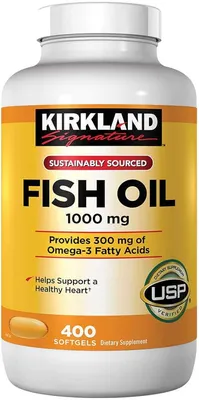
Kirkland Signature Fish Oil 1000mg
Best pure-budget pick for basic omega-3 supplementation. Clean, tested, and absurdly affordable — but the low concentration means you'll swallow more capsules to hit a therapeutic dose. Ideal for adults who want simple baseline omega-3 support without overthinking it.
- Exceptional value — roughly $15 for 400 softgels
- Passes independent purity testing for mercury and contaminants
- Simple, well-established formula from a trusted store brand
- Widely available at Costco and online retailers
- Low omega-3 concentration — only 300mg EPA/DHA per 1000mg softgel
- Need 3-4 capsules daily for a heart-health dose
- Standard ethyl ester form — less bioavailable than triglyceride form
Kirkland Signature Fish Oil 1000mg is the best budget omega-3 for adults over 50 who want a basic fish oil at the lowest possible cost. At roughly $15 for 400 softgels, it delivers 300mg of combined EPA/DHA per capsule — a modest but meaningful dose when taken as directed. If your goal is simple, affordable, long-term omega-3 supplementation, Kirkland gets the job done.
What Is Kirkland Signature Fish Oil?
Kirkland Signature is Costco’s house brand, and their fish oil is one of the best-selling omega-3 supplements in the United States. The appeal is straightforward: it’s a standard 1000mg fish oil softgel that costs less per serving than almost any competitor. Costco has built its entire business model on delivering reliable quality at warehouse prices, and their fish oil follows the same playbook.
This is not a premium concentrated formula. It’s not a specialty triglyceride-form omega-3. It’s a basic, well-made fish oil softgel priced so low that there’s essentially no financial barrier to daily omega-3 supplementation. For many adults over 50, that accessibility is exactly the point — the best supplement is the one you actually take consistently.
What’s Inside
Each 1000mg softgel contains approximately 300mg of combined omega-3 fatty acids, split roughly 180mg EPA (eicosapentaenoic acid) and 120mg DHA (docosahexaenoic acid). The remaining 700mg is other fish oil fats that are not harmful but don’t carry the same cardiovascular benefits.
The 30% omega-3 concentration is standard for basic fish oil — this is what most grocery store and drugstore fish oils provide. Premium concentrated formulas deliver 60-80% omega-3 concentration, giving you more EPA/DHA per capsule.
Other ingredients include gelatin (softgel shell), glycerin, and water. The oil is molecularly distilled to remove mercury, PCBs, and other contaminants — a standard purification process used across the fish oil industry.
What the Research Says
The cardiovascular benefits of omega-3 fatty acids are supported by decades of research. The VITAL trial, a massive randomized study of over 25,000 adults, found that omega-3 supplementation (840mg EPA/DHA daily) reduced the risk of heart attack by 28%, with an even stronger 40% reduction among participants who ate less than 1.5 servings of fish per week.
EPA specifically has strong evidence for cardiovascular protection. The REDUCE-IT trial demonstrated that high-dose EPA (4g daily of icosapent ethyl) reduced major cardiovascular events by 25% in patients with elevated triglycerides. While that study used pharmaceutical-grade prescription EPA at much higher doses, it confirmed that omega-3s have real, measurable cardiovascular effects.
For triglyceride reduction, a meta-analysis of 68 randomized trials found that fish oil supplementation reduces triglyceride levels by 15-30%, with greater effects at higher doses. The American Heart Association recommends 2-4g of EPA/DHA daily for triglyceride management — a dose that would require many Kirkland softgels, which is where concentrated formulas become more practical.
For general heart health maintenance, 500-1000mg of combined EPA/DHA daily is the range most commonly recommended by cardiologists. That translates to 2-3 Kirkland softgels per day — entirely doable and still remarkably affordable.
Who Is This Best For?
Kirkland Fish Oil is a strong fit if you:
- Want basic omega-3 support at the lowest possible cost — at roughly 4 cents per softgel, you can supplement for an entire year for under $15-30 depending on your dose
- Don’t eat fatty fish regularly — if salmon, mackerel, and sardines rarely appear on your plate, even a modest fish oil supplement fills an important nutritional gap
- Prefer a simple, no-frills approach — one product, one ingredient, well-tested, widely available
- Are starting omega-3 supplementation for the first time — Kirkland is a low-risk way to see how you tolerate fish oil before investing in a premium formula
If your doctor has recommended higher omega-3 doses (1000mg+ EPA/DHA daily) for triglycerides or cardiovascular risk, a concentrated formula like Viva Naturals Triple Strength or Nordic Naturals Ultimate Omega delivers more per capsule and may actually save you money at therapeutic doses. But for basic daily maintenance, Kirkland is the budget king.
How to Take It
Take 1-2 softgels daily with a meal containing some fat for best absorption. If your doctor recommends a higher dose, take softgels with different meals throughout the day rather than all at once — this improves absorption and reduces the chance of fishy aftertaste.
Storing your fish oil in the refrigerator keeps the oil fresher and significantly reduces fish burps. Some people freeze the softgels for the same reason, though this can slow digestion and reduce absorption slightly.
Interactions to watch: Fish oil has a mild blood-thinning effect. If you take warfarin, aspirin, or other anticoagulants, let your doctor know you’re supplementing with omega-3s. High doses (above 3g EPA/DHA daily) may increase bleeding risk. Fish oil may also lower blood pressure modestly, which is usually beneficial but should be monitored if you take antihypertensive medication.
Always consult your doctor before starting fish oil supplementation, especially if you take blood thinners or have a scheduled surgery within the next two weeks.
The Bottom Line
Kirkland Signature Fish Oil won’t win awards for potency or sophistication — but it doesn’t need to. It’s a clean, tested, and absurdly affordable way to get daily omega-3s into your routine. For adults over 50 who want a basic foundation of heart-healthy fats without overthinking it or overspending, this is the fish oil to buy.
Frequently Asked Questions
Is Kirkland fish oil good quality?
Kirkland Signature fish oil has passed independent purity testing by organizations like ConsumerLab and IFOS. It meets acceptable limits for mercury, PCBs, and oxidation markers. Costco's Kirkland brand has a track record of delivering reliable quality at low prices. While it's not a premium concentrated formula, the fish oil itself is clean and accurately labeled.
How much EPA and DHA is in Kirkland fish oil?
Each 1000mg softgel provides approximately 300mg of combined omega-3 fatty acids — roughly 180mg EPA and 120mg DHA. This is the standard concentration for basic fish oil (about 30%). Concentrated formulas like Viva Naturals deliver 2-3x more EPA/DHA per capsule. To get the 1000mg of combined EPA/DHA that research supports for heart health, you'd need about 3-4 Kirkland softgels daily.
Should I take Kirkland fish oil or a concentrated omega-3?
It depends on your goals and budget. For general wellness and mild heart health support, 1-2 Kirkland softgels daily provides a baseline of omega-3s at very low cost. If your doctor has recommended higher omega-3 doses for triglycerides, inflammation, or specific cardiovascular concerns, a concentrated formula saves you from swallowing 4+ capsules daily and may actually cost less per milligram of EPA/DHA at higher doses.
Does Kirkland fish oil cause fish burps?
Some users do report fishy aftertaste or burps with standard fish oil, including Kirkland. This typically happens when the oil is slightly oxidized or when capsules dissolve in the stomach rather than the intestine. Storing your fish oil in the refrigerator helps — cold oil is less likely to repeat. Taking capsules with a meal also reduces this. If fish burps are a dealbreaker, enteric-coated or concentrated triglyceride-form omega-3s are less likely to cause this issue.