
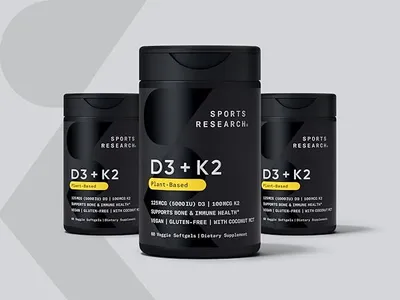
Sports Research Vitamin D3+K2
Best value D3+K2 combo — delivers the optimal pairing of both nutrients in a well-absorbed coconut oil softgel at a price that's hard to beat.
- 5,000 IU D3 + 100mcg K2 (MK-7) in one small softgel
- Coconut oil base for superior fat-soluble absorption
- Excellent value — under $0.30 per day
- Non-GMO verified, made in the USA
- 5,000 IU may be too high for some without testing
- Not third-party certified (NSF/USP)
- Softgel contains gelatin (not vegan)
Sports Research Vitamin D3+K2 is the best value high-dose vitamin D combination for adults over 50. Each small softgel packs 5,000 IU of vitamin D3 alongside 100mcg of vitamin K2 (as MK-7) in an organic coconut oil base — giving you superior absorption of both fat-soluble nutrients without needing to time it with a fatty meal. At under $18 for a 60-day supply, it pairs evidence-based dosing with a price point that makes daily supplementation a no-brainer.
What Is Sports Research Vitamin D3+K2?
Sports Research is a family-owned American supplement company based in San Pedro, California, founded in 1980. While their name suggests an athletic focus, their D3+K2 softgel has become one of the most popular vitamin D supplements across all demographics — and for good reason. It combines the two nutrients that bone and cardiovascular researchers now say should be taken together, in a format that actually makes sense biochemically.
The product is Non-GMO verified, manufactured in the USA in a cGMP-certified facility, and uses organic coconut oil as the carrier. The softgels are small and easy to swallow — a practical detail that matters for daily compliance, especially for adults who already take multiple supplements.
What’s Inside
Each single-softgel serving provides:
- 5,000 IU (125mcg) vitamin D3 (as cholecalciferol — the same form your skin produces from sunlight)
- 100mcg vitamin K2 (as MK-7 — the most bioavailable and longest-acting form of K2)
- Organic coconut oil (carrier for fat-soluble absorption)
That’s it. No fillers, no artificial colors, no unnecessary additives. The softgel shell is bovine gelatin with glycerin and purified water.
The MK-7 form of K2 is important. Unlike MK-4 (which has a half-life of just a few hours), MK-7 stays active in your bloodstream for approximately 72 hours, meaning a single daily dose maintains consistent levels. This is the form used in most of the positive K2 clinical trials.
What the Research Says
Vitamin D deficiency in adults over 50 is remarkably common. A 2011 study estimated that 41.6% of U.S. adults are vitamin D deficient, with rates exceeding 60% in adults over 65. As you age, your skin produces less vitamin D from sunlight, you spend less time outdoors, and your kidneys become less efficient at converting D to its active form.
The health implications are wide-ranging. A 2014 meta-analysis of 32 studies found that low vitamin D levels were associated with significantly higher rates of cardiovascular disease, cancer, type 2 diabetes, and all-cause mortality. For immune function specifically, a 2017 meta-analysis in the BMJ found that vitamin D supplementation reduced the risk of acute respiratory infections by 12% overall, and by 70% in those who were severely deficient.
The case for adding K2 is equally compelling. A 2015 clinical trial published in Thrombosis and Haemostasis found that 180mcg of MK-7 daily for three years significantly improved arterial stiffness in healthy postmenopausal women. By activating matrix GLA protein, K2 helps prevent the arterial calcification that becomes increasingly common with age.
Who Is This Best For?
Sports Research D3+K2 is an excellent choice if you:
- Have been told your vitamin D is low — 5,000 IU is a standard corrective dose that most doctors recommend for deficiency or insufficiency
- Want D3 and K2 together without buying two separate supplements — this simplifies your routine and saves money
- Are budget-conscious — at under $0.30 per day, this is one of the most affordable quality D3+K2 combinations available
- Prefer small, easy-to-swallow softgels — the coconut oil softgel format is significantly easier than large tablets
- Take calcium supplements — K2 is especially important if you supplement calcium, as it helps direct that calcium to your bones rather than your arteries
If you need a lower dose (1,000-2,000 IU) for maintenance, or if you require NSF or USP third-party certification, consider NatureWise Vitamin D3 5000 (which offers a lower-dose option) or Nordic Naturals D3+K2 (which carries a third-party testing seal).
How to Take It
Take one softgel daily. The coconut oil base means you can take it with or without food — the fat is built into the capsule. That said, taking it with your largest meal of the day may slightly enhance absorption.
Timing tip: Morning or midday is generally preferred. Some research suggests that taking vitamin D late in the evening may interfere with melatonin production, though the evidence on this is mixed.
Interactions to watch: If you take warfarin or other vitamin K-sensitive blood thinners, do not start K2 without your doctor’s guidance — K2 affects clotting factors. If you take thiazide diuretics, be aware that combining them with high-dose vitamin D can increase calcium levels excessively. Ask your doctor to monitor your calcium and 25-hydroxyvitamin D blood levels periodically.
Always consult your doctor before starting vitamin D supplementation, especially at the 5,000 IU dose. A simple blood test can determine your current level and help your doctor recommend the right dose for you.
The Bottom Line
Sports Research Vitamin D3+K2 delivers exactly what current research supports — D3 and K2 together in a well-absorbed format — at a price that makes daily supplementation genuinely affordable. The 5,000 IU dose is appropriate for the many adults over 50 who are deficient or insufficient, and the MK-7 form of K2 provides lasting arterial and bone protection. It lacks the third-party certification seals of some pricier brands, but the formula itself is clean, well-designed, and effective. For adults over 50 who want the best value in a D3+K2 combo, this is our top pick.
Frequently Asked Questions
Why should I take vitamin D3 with K2 instead of D3 alone?
Vitamin D3 increases calcium absorption from your diet, which is beneficial for bones. But without vitamin K2, that extra calcium may deposit in your arteries rather than your bones. K2 activates proteins that direct calcium into bone tissue and keep it out of soft tissues and blood vessels. A 2015 study in the journal Integrative Medicine found that K2 (MK-7) significantly improved vascular elasticity. Taking D3 and K2 together gives you the bone benefits while addressing the cardiovascular safety concern.
Is 5,000 IU of vitamin D3 too much for daily use?
For most adults over 50, 5,000 IU daily is within the safe range, especially if blood levels are low. The Endocrine Society considers up to 10,000 IU daily safe for adults without risk of toxicity. However, the right dose depends on your current blood level, which varies widely. Ask your doctor for a 25-hydroxyvitamin D blood test — if your level is below 30 ng/mL, 5,000 IU daily is a common corrective dose. Once you reach 40-60 ng/mL, your doctor may recommend stepping down to 2,000-3,000 IU for maintenance.
Why is this D3+K2 supplement in coconut oil?
Vitamins D3 and K2 are both fat-soluble, meaning they need dietary fat to be properly absorbed. Sports Research suspends the vitamins in organic coconut oil inside each softgel, providing the fat needed for absorption right in the capsule. This means you don't have to worry about taking it with a fatty meal — the coconut oil handles absorption. Studies confirm that fat-soluble vitamins taken with a fat source show significantly better blood level increases than those taken without fat.
Can I take Sports Research D3+K2 if I'm on blood thinners?
This requires a conversation with your doctor. Vitamin K2 (MK-7) affects blood clotting factors, and if you take warfarin (Coumadin), adding K2 can interfere with your INR levels and medication effectiveness. However, some cardiologists now recommend stable, low-dose K2 alongside warfarin with INR monitoring. If you take newer blood thinners (apixaban, rivaroxaban), K2 interaction is less of a concern, but you should still discuss it with your prescriber.